Mostrar mensagens com a etiqueta falácias-retórica. Mostrar todas as mensagens

2 de março de 2016

O perigo de não ver os "trade-offs" - já tinham pensado nisto?

 Matéria para refletir:


"It’s that once you’ve persuaded yourself of the merits of an argument, three cognitive biases kick in to play down trade-offs:

 - Asymmetric Bayesianism. We tend to be more sceptical about arguments from the opposing side than from our own, with the result that a balanced presentation of the evidence increases our dogmatism.

 - Wishful thinking. For example, those who value national self-determination want to believe that Brexit will also make us better off – and wishes often beget beliefs.

 - The halo effect. We tend to believe that good things go together, even though they needn't. For example, attractive defendants are more likely to be acquitted than ugly ones.  David Leiser and Ronen Aroch have shown (pdf) that this characterizes lay people’s thinking about economics. They show that non-economists apply a “good begets good heuristic”: they tend to believe that good things lead to other good things.  

Berlin went on to write that those who deny trade-offs rest on “comfortable beds of dogma”. He should have added that such beds are easy to make."

Stumbling and Mumbling: Not seeing trade-offs

12 de março de 2011

Civilizações


Samuel Huntington [in] “The Clash of Civilizations?”[wrote that]human beings [...] are divided along cultural lines — Western, Islamic, Hindu and so on. There is no universal civilization. Instead, there are these cultural blocks, each within its own distinct set of values. The Islamic civilization, he wrote, is the most troublesome. People in the Arab world do not share the general suppositions of the Western world. Their primary attachment is to their religion, not to their nation-state. Their culture is inhospitable to certain liberal ideals, like pluralism, individualism and democracy. 

Huntington correctly foresaw that the Arab strongman regimes were fragile and were threatened by the masses of unemployed young men. He thought these regimes could fall, but he did not believe that the nations would modernize in a Western direction. Amid the tumult of regime change, the rebels would selectively borrow tools from the West, but their borrowing would be refracted through their own beliefs. They would follow their own trajectory and not become more Western.The Muslim world has bloody borders, he continued. There are wars and tensions where the Muslim world comes into conflict with other civilizations. Even if decrepit regimes fell, he suggested, there would still be a fundamental clash of civilizations between Islam and the West. The Western nations would do well to keep their distance from Muslim affairs. The more the two civilizations intermingle, the worse the tensions will be. 

Huntington’s thesis set off a furious debate. But with the historic changes sweeping through the Arab world, it’s illuminating to go back and read his argument today. In retrospect, I’d say that Huntington committed the Fundamental Attribution Error. That is, he ascribed to traits qualities that are actually determined by context.


"- Sent using Google Toolbar"

Nunca gostei da tese de Huntington, mais que não fosse, porque atribuo grande importância ao contexto (mas não conhecia o Erro Fundamental da Imputação), e o contexto no caso dos países árabes passa por coisas, como, por exemplo, a (não) resolução do problema palestiniano - livro a ler é o de Robert Fisk, The Great War for Civilisation (foi publicado já em Portugal, e ver também aqui).

27 de fevereiro de 2010

É sobre algumas idéias feitas quanto à inovação, mas tem aplicação em outros domínios

"5. 'There is a huge gap between how an innovator sees the world and how others see the world. Howard Aiken, a famous inventor, said, 'Don't worry about people stealing an idea. If it's original, you will have to ram it down their throats.'' 

6. 'The love of new ideas is a myth: we prefer ideas only after others have tested them. We confuse truly new ideas with good ideas that have already been proven, which just happen to be new to us. The paradox is that the greater potential of an idea, the harder it is to find anyone willing to try it.”"

"9. 'The myth that the best idea wins is dangerous. The goodness or newness of an idea is only part of the system that determines if it will win or lose.'

Ten Myths of Innovation:  Scott Berkun, The Myths of Innovation

1 de novembro de 2009

Um destes dias até poderemos encontrar isto no discurso público

"One of the oldest rhetorical tricks is to emphasize a point by pretending to deny it. This notion is so core to rhetoric that the ancient Greeks even had a few related figures of speech named for it — most broadly, apophasis (from the Greek word for “to deny”), the figure of speech that stresses an idea or image by negating it. [...]

There is a related figure, Paralipsis, [...] is a rhetorical figure of speech wherein the speaker or writer invokes a subject by denying that it should be invoked. [...] Paralipsis is usually employed to make a subversive ad hominem attack. The device is typically used to distance the speaker from unfair claims, while still bringing them up. For instance, a politician might say, “I don’t even want to talk about the allegations that my opponent is a drunk.” … Proslepsis is an extreme kind of paralipsis that gives the full details of the acts one is claiming to pass over [...]" 

Transcrevi isto porque achei o apontamento pedagógico, e por memória.

Tirado de Meet trash journalist Keith Kloor « Climate Progress:

27 de outubro de 2009

Tem a ver com reformas, política, comunicação social... - recomenda-se a leitura

" [...] Shawn Rosenberg's three-fold typology of adult reasoning:
  1. Sequential thinkers reason "by tracking the world," recognize regularities in sequences of events, but have no abstract understanding of cause and effect. The world they perceive is a world of appearances that has very little organization to it beyond the recurrence of sequences. 
  2. Linear thinkers understand cause and effect, limited to a one-direction, one-cause/one-effect model. The world they perceive has logical order and structure, but the structure is invariably hierarchical, causality flows top-down, and the world is divided neatly into cause and effect. 
  3. Systematic thinkers understand multi-faceted, multi-linear cause and effect, with mutual cause-and-effect relationships between different elements. The world they perceive is primarily a world of systems and relationships, rather than objects. The world that systemic thinkers perceive is a much more realistic picture of the world we live in than that of either sequential or linear thinkers. Mutual cause and effect means that everything effected can also be a cause in return. Multi-faceted means that one cause can have many different effects. Multi-linear means that there can be multiple chains of causation interacting with one another. Put them all together and it's virtually inevitable that anything you do will have both good and bad effects. But that hardly means they have to be equal to one another, and therefore you'd be better off doing nothing. 
Yet, that has generally been the conservative conclusion. The world as it is cannot be improved on--or at least not very much. That is the traditional conservative position. The world is conceived of as a vast organismic whole too complex and mysterious for us go mucking about with.[...]"

[de acordo com] "Albert Hirschman's typology "The Rhetoric of Reaction: Perversity, Futility, Jeopardy": Here's the thing: as history progresses, things change. And societies try to adapt to those changes.

Experts come up with solutions to the problems the societies face. Those solutions often entail discomfiting established interest groups. And the solutions the experts come up with almost always entail some degree of perverse counterreaction, some kinds of problems or inefficiencies or whatever. It can be very interesting to focus on those counterreactions; it can generate fascinating, eye-grabbing journalism.

But in the overwhelming majority of cases, the counterreactions aren't as big as the first-order effects of the solutions. The minimum wage may price a few people out of the labour market, but it mostly raises low-income people's wages. Raising marginal income taxes does slightly lower rich people's incentives to generate income, but it mostly raises government revenue. In other words, the little contrarian thing is almost never anywhere near as important as the big first-order thing it rides on. And as journalism has come increasingly to focus on contrarianism, it has become less and less adept at actually describing the world".


17 de outubro de 2009

Enviesamentos

"[...] I reviewed with the residents three principal biases these researchers studied: "anchoring," where a person overvalues the first data he encounters and so is skewed in his thinking; "availability," where recent or dramatic cases quickly come to mind and color judgment about the situation at hand; and "attribution," where stereotypes can prejudice thinking so conclusions arise not from data but from such preconceptions."
Tirado de Diagnosis: What Doctors Are Missing - The New York Review of Books. É uma recensão de livros sobre a saúde norte-americana.

12 de agosto de 2009

Sobre os economistas e a crise (III)


Sobre este ponto têm-se escrito, e discutido, imenso: no The Economist, no Financial Times, etc., nos blogues destes jornais, na blogosfera dos economistas. Não acompanhei tudo, e muito do que guardei (no Delicious) ficou para ler depois, daí que o que vem abaixo (que é muito, mas é para arrumar a casa), nem é tudo, nem asseguro que seja o mais interessante, mas tem interesse suficiente para merecer uma leitura.


O artigo Experts & the demand for certainty, by Chris Dillow, não se enquadra bem sob a epigrafe desta nota, mas fica aqui porque acaba por estar ligada à discussão, ainda que indirectamente - é por ele, e por aquele que o segue, que esta nota é classificada com a etiqueta falácias:


  • Paul Krugman's Views differ on the shape of macroeconomics "I’ll mostly weigh in on Brad DeLong’s side with regard to this Economist piece on the state of macroeconomics. The Economist reaches, I think, for a false symmetry, and glosses over too easily the sheer ignorance that has become obvious in the debates over fiscal policy. On the other hand, the common claim that economists ignored the financial side and the risks of crisis seems not quite fair — at least from where I sit. In international macro, one of my two home fields, we’ve worried about and tried to analyze crises a lot. Especially after the Asian crisis of 1997-98, financial crises were very much on everyone’s mind. There was a substantial empirical literature from economists like Carmen Reinhart and Graciela Kaminsky (with Ken Rogoff joining in latterly); there was modeling from Guillermo Calvo, Jose Velasco, Nouriel Roubini, Paolo Pesenti, and others, including yours truly. Speaking for myself, I saw the housing bubble and expected the bust; but I hadn’t appreciated in advance either the vulnerability of the shadow banking system or the leverage of American consumers. Once the crisis was underway, however, I had a more or less ready-made intellectual framework to accommodate these revelations: at a meta level, this was very much the same kind of crisis as Indonesia 1998 or Argentina 2002. Domestic macro people may have been more astonished by what happened. But the prevailing trend now is to assert that there are more risks in the economy than were dreamed of in our philosophy; I don’t think that’s fair".


  • Economist's View: "Economists on Trial" This is part of an interview of heterodox economist Michael Perelman: Michael Perelman, on Market Myths, Past and Present, by Seth Sandronsky: ...[Seth] Sandronsky The Depression of the 1930's changed the public policy views of some in the economics profession. In brief, what were the main changes, and how do they connect with the post-bubble economy of mid-2009? Perelman The Great Depression severely tarnished economists' reputations. For example, The Economist published an article on 17 June 1933, entitled "Economists on Trial," which described a "mock-trial - not entirely mockery -" of "the economists." The trial was staged at the London School of Economics, with Robert Boothby, M.P., representing "the state of the popular mind." He accused the economists with "conspiring to spread mental fog," charging that they "were unintelligible; that they had in general proved wrong; and that in any case they all disagreed." The economists - Sir William Beveridge, Sir Arthur Salter, Professor T. E. Gregory, and Hubert Henderson - were all highly respected in the field. They answered Boothby's charges without wholly refuting them. The article concluded, "There was never a time when the advice of an expert was so often asked and so seldom followed as the present." According to the magazine, the problem was that the authorities did not listen to the economists. At the same time, during the New Deal economists played a very prominent role. For the most part, they had not previously been among the doctrinaire defenders of laissez-faire. But keep in mind that, until the post-World War II era, the economics profession was much more diverse. A good number of progressive economists had been purged from academia, but some progressives remained. The more elite a university was, the less diversity it had. Yet, even in elite universities there was a modicum of diversity. Although the discipline of economics became radically more conservative after World War II, during the 1970's economists who were active during the Depression tended to give me a much more sympathetic hearing, even if they had drifted considerably to the right. Today, the makeup of the economics profession has changed dramatically. The economists who experienced the Great Depression are gone. On virtually any campus, the economics department will be among the most conservative. Dissenting views are rarely tolerated, except in liberal arts colleges. Catholic colleges also tend to be less fearful of unorthodox views. However, the government's stimulus plans - under both Bush and Obama - have been so inept that a good number of very conservative economists have been highly critical in ways that do not entirely differ from my own. Perhaps what is most surprising is how little influence economists have had in the policy realm. Virtually no Congressional hearings have called upon economists, whether they are conventional or radical. How much influence economists - other than Larry Summers - have had behind closed doors is an open question. ...


  • Experts & the demand for certainty, by Chris Dillow: It’s a bad day for experts. The Timescomplains that economic forecasters are as blind as ancient soothsayers, whilst proof that Colin Stagg was innocent discredits Paul Britton’s expertise as a forensic pyschologist. To point out that experts are wrong, however, is to misunderstand the purpose of them. Their function is not to provide knowledge, and still less clear thinking. Instead, it is to provide certainty. People hate dissonance, doubt and uncertainty. Experts help dispel these. So, Paul Britton’s function was to tell the police that they had the right man, whilst economic forecasters’ job is to provide an impression that the future is knowable; no-one wants to hear about standard errors, parameter uncertainty or the Lucas critique. What’s so pernicious here, though, is that people have ways of achieving an illusory certainty anyway. As Sir Harry Ognall - the judge who acquitted Stagg -says: “The police closed their minds to any other possibility than that of his guilt.” There are several ways they got these closed minds. All have analogues in corporate planning and financial trading. 1. The confirmation bias. Having acquired the belief that Stagg was guilty - he fitted the profile, was on the scene and a bit of a weirdo - subsequent evidence was interpreted as corroborating this. So, the fact that he looked shifty in interview was seen as evidence of guilt, not as the sign of an innocent man nervous of being fitted up. A similar thing happens in economic forecasting. If you thought last week that we’re heading for a very deep recession, you put great weight on Wednesdays’s jobless numbers and find ways of dismissing yesterday’sretail sales figures. If you thought the recession would be mild, you do the opposite. 2. The halo effect. In their book, Mistakes were Made, Carol Tavris and Elliot Aronson describe how policemen believe “I couldn’t have been wrong because I’m a good guy.” Even if we grant the premise, the error here lies in believing that good qualities - moral rectitude and cognitive skills - must be correlated. They are not. Of course, coppers are not unique in thinking this. 3.Groupthink. If our colleagues agree with us, our confidence in our judgment rises, especially if we like them. This error arises in part because we fail to see that correlated data points add little to certainty. If our colleagues have the same training and evidence as us, and are also prone to groupthink, their beliefs will be correlated with ours, and so will not be new evidence - no more than a second copy of the Daily Mail corroborates the stories made in the first. But we interpret them as if they are. 4. Ego-involvement. Admitting that we are wrong means more than just fessing up to narrow technical error. We interpret it as a blow to our ego - a sign that we are not the infallible, uber-competent professionals we think. We’ll do anything to squirm out of facing this. Hence the failure of the police, until yesterday, to apologize to Colin Stagg, and the failure of many bank bosses, Tom McKillop excepted, to apologize for their errors. And herein lies the purpose of experts. It’s to reinforce these mechanisms, to help people avoid the uncomfortable facts that the world is uncertain, that mistakes are inevitable, and that we are not as in control of things as we think. Blaming experts for being wrong is like complaining that the economy is not yellow. It’s a category error so howling as to be nonsensical.


  • EVER wondered why the pundits who failed to predict the current economic crisis are still being paid for their opinions? It's a consequence of the way human psychology works in a free market, according to a study of how people's self-confidence affects the way others respond to their advice. The research, by Don Moore of Carnegie Mellon University in Pittsburgh, Pennsylvania, shows that we prefer advice from a confident source, even to the point that we are willing to forgive a poor track record. Moore argues that in competitive situations, this can drive those offering advice to increasingly exaggerate how sure they are. And it spells bad news for scientists who try to be honest about gaps in their knowledge. Humans prefer cockiness to expertise - life - 10 June 2009 - New Scientist


  • The Anti-Macroeconomics Roar Grows Louder - Freakonomics Blog - NYTimes.com In my opinion, the fundamental problem is this: from a modern academic perspective, the sorts of skills that accompany having a good working knowledge of the macroeconomy are not easily measured by, and are not rewarded in, the current incentive schemes for economists. In microeconomics, at least there is an abundance of good data, so people who are good at measuring and describing things can succeed. But in macro there is not much data, so most of the rewards are for the mathematics, not the empirics. The single easiest way to make a mark in a modern macro paper is to solve a problem that is really, really hard mathematically. Even if it is not that relevant to anything, it is seen as a sign that the author has “impressive skills,” which is enough to get a job — and even tenure sometimes — at top universities.


  • Time magazine has kindly included me in its annual list of The 100 Most Influential People in the World. I do not know if I deserve to be in such a list as there are so many others who influence so much of our world. But I certainly recognize that there were a small but significant number of economists, thinkers and analysts who – early on – predicted many of the risks and vulnerabilities that eventually led to this crisis. In many ways I simply connected the dot in these different strands of thinking and warnings. Among a few others Robert Shiller was one of the earliest ones to study in detail and warn about a housing bubble; Kenneth Rogoff and a few other economists warned early on about the unsustainability of the US current account deficits and of the global imbalances; Raghu Rajan presented one of the earliest and sharpest analyses of the agency problems and incentive distortions deriving from compensation schemes in financial institutions; Nassim Taleb and a few other finance scholars stressed the risk of fat tail extreme events in financial markets; Paul Krugman – who received his Nobel for his trade contributions – was the father of currency and financial crisis theories in international macro as at least three generations of currency crisis models were developed from his seminal work; Stephen Roach, David Rosenberg and a few other financial sector analysts warned about the shopped-out, saving-less, bubble-addict and debt-burdened US consumer ; Niall Ferguson provided vivid comparisons between historical episodes of financial crises and current vulnerabilities; Hyun Shin and other scholars in academia provided early modeling of illiquidity and of the perverse effects of leverage during asset bubbles; William White and his colleagues at the BIS were among the first – following the scholarship of Hyman Minsky – to analyze how the “Great Moderation” may paradoxically lead to “Financial Instability”, asset and credit bubbles and financial crises; Gillian Tett and a few other journalists at the Financial Times provided early clear explanations of the arcane complexity of credit derivatives and structured finance and of the systemic risks deriving from these new exotic financial instruments; dozen of serious and deep thinking scholars in academia modeled analytically – and tested empirically - the various aspects of systemic financial crises and the interactions between currency crises, systemic banking crises, systemic corporate and household debt crises and sovereign debt crises. RGE - The thinkers who predicted early on many aspects of this financial crisis


  • The night they reread Minsky - Paul Krugman Blog - NYTimes.com Brad DeLong offers a neat little model of speculative fluctuations in asset prices, based on the idea that investors gradually switch strategies based on what seems to work for other people: if people buying stocks seem to be doing well, more people move into stocks, driving up prices and making stocks look even more attractive. It’s very close to Shiller’s notion of bubbles as natural Ponzi schemes. And Brad’s version is very much what I was saying in this piece written in 1999 — one I had a lot of fun writing.


  • Revisiting Economics 101 Free exchange Economist.com Over the weekend, Greg Mankiw took stock of how the teaching of basic economics will change as a result of the crisis. It is a very exciting time to be teaching and researching in the field, though the introductory courses will probably not change so much. Economics provides a tool kit to think about the world. Basic concepts like supply and demand and how to distribute a fixed amount of resources have not changed. If anything, basic economics will take a harder look at how aspects of the financial system lead to market failure. Perhaps there will be more humility. In the past students have learned economics under the presumption that systematic bank failure, rampant inflation and unsustainable debt were the terrain of developing economies. The developed world, it was thought, understood policy well enough to prevent those things from occurring. American economists probably no longer take that for granted. Many people, even in the field, lost sight of what economics is meant to do, which is provide a framework for thinking about problems rather than forecasting the future. So, Mr Mankiw writes It is fair to say that this crisis caught most economists flat-footed. In the eyes of some people, this forecasting failure is an indictment of the profession. But that is the wrong interpretation. In one way, the current downturn is typical: Most economic slumps take us by surprise. Fluctuations in economic activity are largely unpredictable. Yet this is no reason for embarrassment. Medical experts cannot forecast the emergence of diseases like swine flu and they can’t even be certain what paths the diseases will then take. Some things are just hard to predict. Likewise, students should understand that a good course in economics will not equip them with a crystal ball. Instead, it will allow them to assess the risks and to be ready for surprises. At the very least, classroom discussion will be more dynamic.


13 de junho de 2009

Uma história de pescas como metáfora de outras coisas


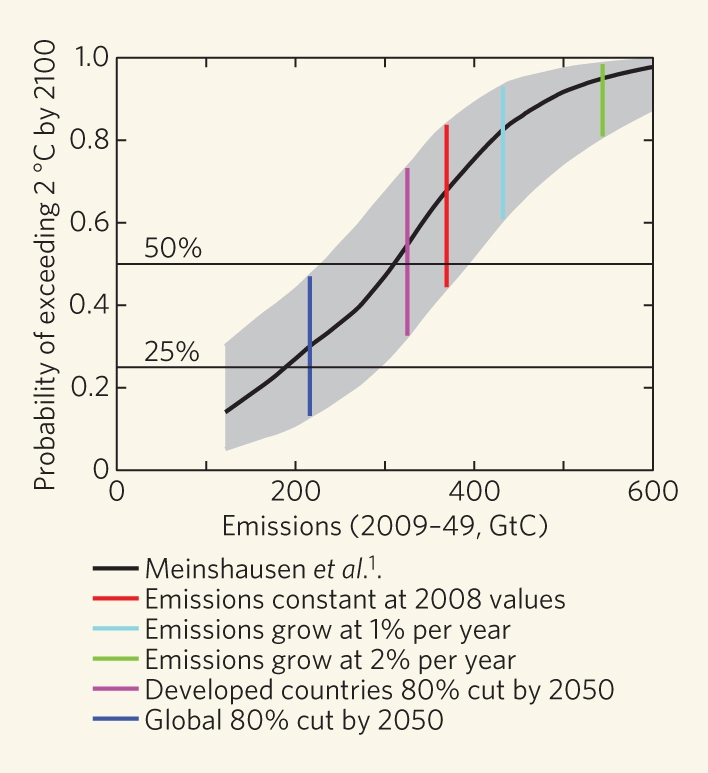
A tragédia dos comuns (climáticos) é o título desta nota do RealClimate. É uma história sobre as pescas, em si mesma (muito) importante, mas funciona como metáfora de tudo o que gira à volta das políticas de combate ao aquecimento global:


"Imagine a group of 100 fisherman faced with declining stocks and worried about the sustainability of their resource and their livelihoods. One of them works out that the total sustainable catch is about 20% of what everyone is catching now (with some uncertainty of course) but that if current trends of increasing catches (about 2% a year) continue the resource would be depleted in short order. Faced with that prospect, the fishermen gather to decide what to do. The problem is made more complicated because some groups of fishermen are much more efficient than the others. The top 5 catchers, catch 20% of the fish, and the top 20 catch almost 75% of the fish. Meanwhile the least efficient 50 catch only 10% of the fish and barely subsist. Clearly, fairness demands that the top catchers lead the way in moving towards a more sustainable future.

The top 5 do start discussing how to manage the transition. They realise that the continued growth in catches - driven by improved technology and increasing effort - is not sustainable, and make a plan to reduce their catch by 80% over a number of years. But there is opposition - manufacturers of fishing boats, tackle and fish processing plants are worried that this would imply less sales for them in the short term.
Strangely, they don't seem worried that a complete collapse of the fishery would mean no sales at all - preferring to think that the science can't possibly be correct and that everything will be fine. These manufacturers set up a number of organisations to advocate against any decreases in catch sizes - with catchy names like the Fisherfolk for Sound Science, and Friends of Fish. They then hire people who own an Excel spreadsheet program do "science" for them - and why not? They live after all in a free society.

After spending much energy and money on trying to undermine the science - with claims that the pond is much deeper than it looks, that the fish are just hiding, that the records of fish catches were contaminated by being done near a supermarket - the continued declining stocks and smaller and smaller fish make it harder and harder to sound convincing.
So, in a switch of tactics so fast it would impress Najinsky, the manufacturers' lobby suddenly decides to accept all that science and declares that the 'fish are hiding' crowd are just fringe elements. No, they said, we want to help with this transition, but …. we need to be sure that the plans will make sense. So they ask their spreadsheet-wielding "advocacy scientists" to calculate exactly what would happen if the top 5 (and only the top 5) did cut their catches by 80%, but meanwhile everyone else kept increasing their catch at the current (unsustainable rate).
Well, the answers were shocking - the total catch would be initially still be 84% of what it is now and would soon catch up with current levels. In fact, the exact same techniques that were used to project the fishery collapse imply that this would only delay the collapse by a few years! and what would be the point of that? [ver a nota anterior denominada Falácias]

The fact that the other top fishermen are discussing very similar cuts and that the fisherfolk council was trying to coordinate these actions to minimise the problems that might emerge, are of course ignored and the cry goes out that nothing can be done. In reality of course, the correct lesson to draw is that everything must be done.


In case you think that no-one would be so stupid as to think this kind of analysis has any validity, I would ask that you look up the history of the Newfoundland cod fishery. It is indeed a tragedy. And the connection to climate? Here.


See here for a much better picture of what coordinated action could achieve [é o gráfico coloco no início desta nota]. "

Falácias


  1. Não conhecia as falácias compendiadas na "retórica da reacção". Em Outras Margens: Ainda Lisboa e os automóveis ela é referida no quadro da discussão dos argumentos apresentados contra a aplicação de uma taxa de congestão ao trânsito em Lisboa. A nota é muito interessante por isso mesmo, e deve ser lida. Fica aqui um excerto para enquadrar o conceito, mas também para ilustrar aquela discussão - no 2º ponto da nota reproduzo uma síntese do que é a "retórica da reacção".
    "A resposta é típica daquilo a que, um dia, outro economista chamou a "retórica da reacção": um pessimismo supostamente "realista", que aponta efeitos nulos ou mesmo perversos a uma proposta de mudança, e que avança, em alternativa, um chavão genérico. Mas se é "pessimismo realista" que queremos, aí vai: enquanto não houver barreiras significativas à entrada de veículos em Lisboa, as câmaras dos concelhos limítrofes e o Governo podem ficar descansados. Podem continuar a acrescentar faixas de rodagem às estradas que acedem a Lisboa, sem que as pessoas que lá vivem sintam real necessidade de exigir mais e melhores transportes públicos, especialmente dos locais onde vivem para os terminais ferroviários e fluviais. Podem dar prioridade a mais umas rotundas com fontes no meio, em vez de construírem parques de estacionamento junto a esses terminais. Podem continuar a dizer que "não há meios". Que o "verdadeiro problema" é outro (é sempre outro). E podem fazer reuniões, seminários e debates sobre esse "verdadeiro problema". Por exemplo, a "constituição da região político-administrativa de Lisboa". Boa sorte com isso, então. "
  2. Retirado de Issue for Week of November 27, 2005:
    "One of the texts I want to briefly summarize for you is Albert O. Hirschman's The Rhetoric of Reaction. Hirschman wrote this book for a think tank during the Reagan administration when liberals were horrified at what conservatives were doing to our safety nets (like having places to house and care for the mentall ill, that Reagan disbanded and did not replace in California). With the objective of getting liberals and conservatives to listen to one another in good faith in the interest of understanding the need for safety nets for the poor and those in crisis or catastrophe, Hirschman listened carefully to both sides. He came up with the startling conclusion that neither side was listening to the other. Both liberals and conservatives were using the same basic arguments to deny any need to hear the Other.
    Hisrchman classified these denials as:
    The Perversity Thesis This reaction to an opponent says that no matter what he does, it's going to turn out just the opposite of what he intended.
    Here's how Hirschman puts it, on p. 11:
    "This is, at first blush, a daring intellectual maneuver. The structure of the argument is admirably simple, whereas the claim being made is rather extreme. It is not just asserted that a movement or a policy will fall short of its goal or will occasion unexpected costs or negative side effects: rather so goes the argument, the attempt to push society in a certain direction will result in its moving all right, but in the oppostie direction. Simple, intriguing, and devastating (if true), the argument has proven popular with generations of "reactionaries" as well as fairly effective with the public at large. In current debates it is often invoked as the counterintuitive, counterproductive, or most to the point, perverse effect of some "progressive" or "well-intentioned" public policy. (fn. omitted) Attempts to reach for liberty will make society sink into slavefy, the quest for democracy will produce oligarchy and tyranny, and social welfare programs will create more, rather than less, poverty. Everything backfires.
    The Futility Thesis This reaction to an opponent says that no matter how much you struggle to change it, it always comes back to the same thing, greed. You can't change that. So where the perversity argument suggest that you can get change, but that change goes in the opposite direction from what you plan, the futility argument suggests that you can really get fundamental change, period.
    Here's how Hirschman puts it on p.43-44:
    "[The futility] argument . . . says that the attempt at change is abortive, that in ine way or another any alleged change is, was, or will be largely surface, facade, cosmetic, heance illusory, as the "deep" structures of society remain wholly untouched." . . . "[O]ne of the best-known (and best) jokes to come out of Eastern Europe after the installation of Communist regimes there in the wake of World War II: "What is the difference between capitalism and socialism?" The answer: "In capitalism, man exploits man; in socialism, it's the other way round." Here was an effective way of asserting that nothing basic had changed in spite of the total transformation in property relations.Finally, Lewis Carroll's proverbial saying in Alice in Wonderland, "Her it takes all the running you can do, to keep in the same place" expresses yet another facet of the futility thesis, placing it in a dynamic setting."
    The Jeopardy Thesis The Jeopardy Thesis acknowledges that change can take place without going in the opposite direction to the one you planned, or without only superficial changes occuring, but it suggests that the cost of such change is so prohibitive that it places the whole society in jeopardy. In other words, you may get a poverty safety net, but only at the cost of taking the righteously earned profits of the rich (who make the law as the holders of power). Or you might pay the social security you promised to the elderly, but only at the cost of having to give up your pet wars.
    Here's how Hirschman puts it on p. 81:
    "The arguments of the perverse effect and of the futility thesis proceed along very different lines, but they have something in common: both are remakably simple and bald___therein, of course, lies much of their appeal [in dominant discourse]. In both cases it is shown how actions undertaken to achieve a certain purpose fail miserably to do so. Either no change at all occurs or the action yields an outcome that is the opposite of the one that was intended. It is actually surprising that I was able to account for a large and important portion of the reactionary arguments with these two extreme categories. For there is a third, more commonsensical and moderate way of arguing against a change which, because of the prevailing state of public opinion, one does not care to attack head-on (this, I have claimed, is a hallmark of "reactionary" rhetoric): it asserts that the proposed change, though perhaps desirable in itself, involves unacceptable costs or consequences of one sort or another."
    I hope these brief examples of Hirschman's work will help you see the complexity of getting us into real substantive discourse. It's so much easier to stop with the simple perverse or fertility thesis, or hide behind the jeopardy of overwhelming "costs." I have put up a brief bit of exchange from transform_dom. Check it out, look at the actual exchanges, and consider how comfortably and securely we avoid good faith efforts to hear one another.
    Mevysen fusses or "corrects," in the hope it will make you listen in good faith; I coerce by luring you with points on which we can agree; Beau overwhelms us with erudition we can't match; Kathleen gently persuades us. We all struggle with avoiding the rhetoric of reaction in different ways. My own assessment, despite circumstances dragging me away from the participation I hoped for, is that you're doing a pretty good job of dragging each other, sometimes gently, sometimes roughly, toward paths around what Hirschman described as the pitfalls of substantive discourse.

Ora bem: apliquemos o conhecimento destas falácias à desmontagem de alguns discursos políticos em presença, e sejamos por isso melhores cidadãos - bem precisamos disso (e eu não estou a falar da abstenção).