21 de novembro de 2009

Leituras sobre a conjuntura económica e economia (I)

  • Cenário de choque divulgado pela Société Générale - Expresso.pt: "Não sendo uma previsão, mas 'uma exploração de perigos', o panorama para os próximos três a quatro anos nos países desenvolvidos, alvitrado pelo relatório negro de 68 páginas divulgado ontem pela Société Générale (SG), aponta para crescimento 'anémico' à japonesa, regresso à ortodoxia orçamental, riscos de inflação ou de estagflação em 2012 [...], e de oportunidades em algumas commodities que denotam tendência altista. A questão crítica, segundo o relatório de choque, poderia resumir-se à expressão de campanha política: É a dívida (pública), estúpido! Intitulado 'Worst-Case Debt Scenario', com a assinatura do analista de estratégia Daniel Fermon [...]  
Segundo o cenário, a dívida pública externa (não incluindo a dos privados) dos Estados nos países desenvolvidos passará, em média, de 75% do produto interno bruto (PIB) de cada país em 2007 (antes da Grande Recessão) para 115% no próximo ano. [...]  Fermon foi questionado sobre quais os caminhos prováveis face a este disparo da dívida pública. O analista apontou três caminhos, admitindo que um quarto de falência dos Estados (como aconteceu à Islândia) possa ser colocado de parte: regresso de uma dinâmica de inflação muito clara a partir de 2012 [...]; intervencionismo do Estado de sentido distinto ao actual, com vista a aliviar a carga (...]; e inovação acelerada à la Schumpeter [...]. No campo da intervenção dos governos, [...]: a) reprivatizações; b) aumento dos impostos (e das receitas fiscais); c) redução drástica pelo lado da despesa dos Estados; c) desvalorizações competitivas da moeda. [...] Alguns analistas acusam este tipo de relatórios como sendo veículos de pressão sobre os governos para o abandono das políticas anticrise que já estariam a durar excessivamente.
  • "Where will we be in one year? | Free exchange | Economist.com: "The good news is, the OECD's latest economic forecast revises up sharply projected economic growth for member nations. The bad news is, that still leaves OECD economies in pretty dismal shape. [...] And as you can see, things will like be as bad or worse in the euro zone, particularly around the periphery. So where will we be in one year? Well, if things continue on in this manner, the developed world will be concluding a second consecutive year of near-record high unemployment, and entering a third. The international economic institutional architecture developed in the wake of the Second World War has simply not been tested under these circumstances."
  •  Top-down versus bottom-up macroeconomics | vox - Research-based policy analysis and commentary from leading economists: "Hayek argued that no individual is capable of understanding the full complexity of a market system. Instead, individuals only understand small bits of the total information. The main function of markets consists in aggregating this diverse information. If there were individuals capable of understanding the whole picture, we would not need markets. This was in fact Hayek’s criticism of the “socialist” economists who took the view that the central planner understood the whole picture and would therefore be able to compute the whole set of optimal prices, making the market system superfluous.
Rational expectations models as intellectual heirs of central planning [?]  My contention is that the rational expectations models are the intellectual heirs of these central-planning models. Not in the sense that individuals in these rational expectations models aim at planning the whole, but in the sense that, as the central planner, they understand the whole picture. These individuals use this superior information to obtain the “optimum optimorum” for their own private welfare. In this sense, they are top-down models."
  • Balancing Fiscal Support with Fiscal Solvency « iMFdirect: "As I noted in my last post, government deficits in many countries—particularly in advanced countries—have jumped dramatically in the wake of the global crisis, and government debt has reached levels that could jeopardize longer term macroeconomic stability and growth. These countries will need to tighten fiscal policy significantly sometime down the road, especially where demographic trends are pushing up health and pension spending. But fiscal deficits cannot be lowered in the immediate future. For the time being, fiscal (and monetary) policies must continue to support economic activity. The economic recovery is uneven and could be threatened by any premature withdrawal of policy support. Private demand is still unable to stand on its own two feet. This gives rise to a policy conundrum. How can we reconcile the competing requirements of short-term support for the economy and longer term fiscal solvency?"

20 de novembro de 2009

Açores e renováveis: muito bem!

:ILHAS: Eficiência energética:

"[...] em Outubro deste ano, a ilha das Flores esteve 12 dias a funcionar exclusivamente com recurso a energias renováveis, numa situação inédita a nível nacional e que nos deixa a todos, acredito, orgulhosos. As Flores, a par com São Miguel, são as ilhas dos Açores onde a taxa de penetração das renováveis tem, neste momento, maior incidência, se bem que existam características endógenas favoráveis para que, a curto prazo, a contribuição das energias renováveis na produção de energia eléctrica no arquipélago passe de 28% para 75%, até 2018."

Isso será excelente, mas fico com dúvidas sobre os números: por exemplo, isso acontecerá independentemente do comportamento da procura de electricidade ao longo período até 2018?

Deverão ler a nota do :Ilhas na totalidade.

E continua ... e se o mar satura?

Oceans' uptake of manmade carbon may be slowing:  

"The oceans play a key role in regulating climate, absorbing more than a quarter of the carbon dioxide that humans put into the air. Now, the first year-by-year accounting of this mechanism during the industrial era suggests the oceans are struggling to keep up with rising emissions -- a finding with potentially wide implications for future climate. The study appears in this week's issue of the journal Nature."

A Lua e a água - como já disse, e para variar, água na Lua é uma excelente notícia

Op-Ed Contributor - The Wet Side of the Moon - NYTimes.com:
"Picture a habitat atop a hill in warm sunlight on the edge of a crater near the south pole of the Moon. There are metal ores in the rocks nearby and ice in the shadows of the crater below. Solar arrays are set up on the regolith that covers the Moon’s surface. Humans live in sealed, cave-like lava tubes, protected from solar flares and sustained by large surface greenhouses. Imagine the Moon as the first self-sustainable human settlement away from Earth and a high-speed transportation hub for the solar system. 

We can finally begin to think seriously about establishing such a self-sufficient home on the Moon because last week, NASA announced that it had discovered large quantities of water there. While we have known for decades that the Moon had all the raw chemicals necessary for sustaining life, we believed they were trapped in rocks and thus difficult to extract. The discovery of plentiful lunar water is of tremendous importance to humanity and our long-term survival."

E continua ... incêndios na Austrália, mas podem suceder, também, em Portugal

Australia: Heatwave 'connected to climate change' Climate Ark:

"There's a 'high chance' a heatwave sweeping Australia's southern and eastern states is related to climate change, a scientist at the Bureau of Meteorology says. [...] This (the heatwave) is a truly extreme event,' Dr Stern says. 'Many places have established all-time records for the first half of November.' The Meteorologist says the heatwave is caused by the absense of southerly wind flows. 'There is considerable variability in the climate and we do have in the background [that] the globe has warmed up by nearly a degree celcius over the last 50 years, so temperatures are higher now than they were then."


Democracia, incentivos e desenvolvimento

World Poverty Map - Creating a World Without Poverty - Esquire: "What Makes a Nation Rich? One Economist's Big Answer: Say you're a world leader and you want your country's economy to prosper. According to this Clark Medal winner from MIT, there's a simple solution: start with free elections."

__________
PS (21.11.09): Sobre o mesmo tópico: Do elections in developing countries improve economic policy? | vox - Research-based policy analysis and commentary from leading economists: "There is some evidence that democracies enjoy better economic growth. How do elections, a core component of democracy, impact economic policy? This says that free and fair elections in developing countries improve economic policy by disciplining governments. But infrequent or uncompetitive elections may actually make things worse."

Mais um "Pico": "Pico de solo arável"


"At the Carbon Farming conference in Australia earlier this month, speakers pointed to a problem that has worried environmentalists for about a decade: peak soil. China is losing soil 57 times faster than nature can replace it, [...].  In the United States, conservation practices have helped reduce soil loss, but top soil is still being eroded 10 times faster than it can be replaced, according to the National Academy of Sciences. This is a concern, not only because it limits the amount of food-producing land, but also because soil and the crops that grow in it can help sequester carbon, so the more of it we lose, the more carbon we leave out in the atmosphere."

E existe um problema semelhante nos Açores, embora não saiba do seu grau de virulência - O Professor Farrica referiu o assunto numa aula de sapiência, na Universidade dos Açores, nos primeiros anos da década de 90, mas não me recordo dos pormenores.

Nos próximos anos...

OCDE arrasa Economia portuguesa - Expresso.pt: "As projecções hoje divulgadas, em Paris, dizem que Portugal será o segundo país da OCDE com menor crescimento entre 2011 e 2017. Apenas o Japão está atrás. Neste período, o crescimento de Portugal será de 1,4%, o segundo mais baixo entre os países da OCDE e o mais reduzido na Zona Euro. Os 16 países da Zona Euro vão crescer 2,1% entre 2011 e 2017. Os 30 da OCDE, crescerão 2,6%."

Preocupações

Economist's View: "Transgressing Planetary Boundaries":
"Transgressing Planetary Boundaries, by Jeff Sachs, Scientific American: We are eating ourselves out of house and home. ... The green revolution that made grain production soar gave humanity some breathing space, but the continuing rise in population and demand for meat production is exhausting that buffer. ...  

Food production accounts for a third of all greenhouse gas emissions... Through the clearing of forestland, food production is also responsible for much of the loss of biodiversity. Chemical fertilizers cause massive depositions of nitrogen and phosphorus, which now destroy estuaries in hundreds of river systems and threaten ocean chemistry. Roughly 70 percent of worldwide water use goes to food production, which is implicated in groundwater depletion and ecologically destructive freshwater consumption from California to the Indo-Gangetic Plain to Central Asia to northern China."

E continua ... Já sucedeu


"The findings, reported this week by scientists from the British Antarctic Survey (BAS), the Open University and University of Bristol in the journal Nature could help us understand more about rapid Antarctic climate changes. Previous analysis of ice cores has shown that the climate consists of ice ages and warmer interglacial periods roughly every 100,000 years. This new investigation shows temperature 'spikes' within some of the interglacial periods over the last 340,000 years. 

This suggests Antarctic temperature shows a high level of sensitivity to greenhouse gases at levels similar to those found today. Lead author Louise Sime of British Antarctic Survey said, 'We didn't expect to see such warm temperatures, and we don't yet know in detail what caused them. But they indicate that Antarctica's climate may have undergone rapid shifts during past periods of high CO2.' During the last warm period, about 125,000 years ago, sea level was around 5 metres higher than today."
________
PS: Sobre o mesmo ver: Rising CO2 could cause catastrophic sea level rise finds Antarctic study| Climate Ark: "The British Antarctic Survey found that during past periods of high carbon dioxide, temperatures in Antarctica were up to 6C above current levels. This could cause a sea level rise of up six metres, threatening coastal cities like London, New York and San Francisco. It is the latest research to warn of the consequences of increased greenhouse gases on the Earth's climate. Yesterday a study warned that carbon dioxide produced by man is now rising at record rates putting the world on a pathway for a 6C rise in temperature."

19 de novembro de 2009

História em movimento


Visualizing empires decline from Pedro M Cruz on Vimeo (via Outstanding graphics of the day | Free exchange | Economist.com)

Nota: Pode levar algum tempo a carregar.

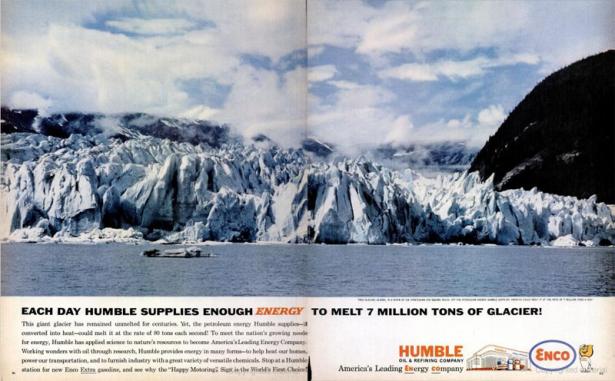
E continua ... Publicidade que não engana!


"From a sharp-eyed reader comes this ad for Humble Oil (which later merged with Standard to become, yes, Exxon). It may win the All Time Millenial Award for Maximal Irony. It’s from a 1962 edition of Life Magazine, available on Google Books (click for larger version):"

Uber-ironic 1962 ad touts oil’s ability to melt glaciers! « Climate Progress

E continua ... A situação alimentar por volta de meados do século XXI


Food for thought | Free exchange | Economist.com

Magnífico


18 de novembro de 2009

E continua ... a evidência dendroclimática


"Figure 1: Median ring-widths (non-overlapping 50-year means) of upper forest border Pinus longaeva from 3 sites in western North America, plotted on first year of interval (from Salzer et al, PNAS, 2009)"

RealClimate: A Treeline Story: "Some of the highest growing trees in the world are also the oldest—bristlecone pines (Pinus longaeva) from the Great Basin in the western United States (eastern California, Nevada and Utah). The oldest example is more than 4800 years old. Because of their longevity and growth at high elevations (where the growth of trees is generally known to be limited by temperature) bristlecone pines have been of particular interest to dendroclimatologists (paleoclimatologists who study tree rings to reconstruct past climate). Numerous ecological studies carried out at treeline sites all over the world show that temperature imposes a critical limitation on the ability of trees to produce new tissue; mean daily temperatures of 8-9°C are required, so recent warming will have particular benefits for those trees that have managed to eke out an existence for so long, living “on the edge”."

Considero curioso que o famigerado pico do aquecimento medieval não surja de modo significativo naquele gráfico, mas estamos a falar de uma zona localizada nos EUA.

Ainda que o meu caro considere que o "aquecimento global" é alarmismo catastrofista (como o Pacheco Pereira), que o assunto é contravertido cientificamente, ou que tem mais que fazer, e mesmo que tivesse razão em tudo isso, não se livrava dos sarilhos que aí vêm e deveria actuar (por outros motivos) exactamente como aquilo fosse verdade


"If you follow the debate around the energy/climate bills working through Congress you will notice that the drill-baby-drill opponents of this legislation are now making two claims. One is that the globe has been cooling lately, not warming, and the other is that America simply can’t afford any kind of cap-and-trade/carbon tax.


But here is what they also surely believe, but are not saying: They believe the world is going to face a mass plague, like the Black Death, that will wipe out 2.5 billion people sometime between now and 2050. They believe it is much better for America that the world be dependent on oil for energy — a commodity largely controlled by countries that hate us and can only go up in price as demand increases — rather than on clean power technologies that are controlled by us and only go down in price as demand increases.


And, finally, they believe that people in the developing world are very happy being poor — just give them a little running water and electricity and they’ll be fine. They’ll never want to live like us. Yes, the opponents of any tax on carbon to stimulate alternatives to oil must believe all these things because that is the only way their arguments make any sense. Let me explain why by first explaining how I look at this issue."

O melhor do argumento vem a seguir.

Pois ... Falaram da energia nuclear para resolver o problema do "Pico do Petróleo"?

FT.com | Money Supply | Peak uranium?: "A report published by MIT suggests the world faces a uranium shortage from 2013."

Pois ... Tenho-o dito, nomeadamente, a propósito das propostas de desagravamento fiscal para os Açores

A citação é feita de um blogue islandês que comecei a seguir há pouco tempo (a nota refere a questão do comportamento das taxas de juro face à inflação, e o impacto que isso teve no descalabro financeiro islandês - a última referência que fiz ao assunto foi feita aqui. A questão é importante por causa da discussão sobre pertencer ou não à Zona Euro):

Bad Economics: "[...] that challenge the wisdom of applying economic theories to large economies and small as if there were no difference."

Reivindicações intempestivas

Causa Nossa: "Os outros que paguem a crise [Publicado por Vital Moreira] «Frente Sindical quer aumento salarial de 2,5% em 2010». Os funcionários públicos tiveram um aumento real de remunerações de cerca de 5% no corrente ano (o que deve ser um record nacional), mercê da imprudente aumento de 3% e da deflação de quase 2% no custo de vida. Agora querem mais 2,5%, com a inerente sobrecarga orçamental. Tendo em conta o aumento exponencial do défice orçamental (que deve superar os 7%), por causa da crise, e a necessidade de contenção da despesa pública, é caso para dizer que os sindicatos da função pública acham que os seus interesses privativos devem prevalecer contra tudo o resto..."

O argumento sindical mais forte invoca a perda de poder de compra dos ordenados da FP ao longo dos anos. Admitindo a bondade do argumento, e esquecendo que a oferta de bens públicos e semi-públicos é cara no país devido à ineficiência e falta de produtividade, e não olhando para a discussão da questão em outros países europeus (na Irlanda discute-se a diminuição dos salários nominais dos funcionários públicos), a reivindicação é completamente intempestiva face à situação económica do país que é particularmente grave.

Os sindicatos da FP deveriam manifestar-se, e fazer greve, e denunciar o que está mal (por exemplo, situações de corrupção e de desperdício) e o que deveria ser feito para melhorar o funcionamento da Administração Pública porque assim exige o interesse dos seus associados - sem ganhos de eficiência e de produtividade, não pode haver melhorias salariais além da reposição do poder de compra perdido pela inflação (e nesta conjuntura, enfim...).

E continua ...Copenhaga, a ciência e a política


“ If there is a bright side, however, the deliberate downshift in expectations for Copenhagen could make it easier for world leaders, including Obama, to attend the summit and draft a stronger political agreement. In addition, diplomats could build out the framework of a future agreement, with the hope that, should the Senate pass carbon legislation early next year, a deal with real numbers could be finalized relatively quickly. But there’s no getting around the fact that as the science of climate change grows more dire, the global political system seems increasingly unable to deal with that reality. “We don’t want a global suicide pact,” said Mohamed Nasheed, the president of the Maldives, a low-lying Indian Ocean nation that could be swamped by global warming – caused flooding. “We want a global survival pact.” But the world’s most influential leaders still aren’t ready for that."

E continua... E em Portugal existem pessoas do sector preocupadas?


"Spain—With the Copenhagen climate change summit looming, the world of wine convened on Spain’s Rioja region for a conference in which global warming emerged as the industry’s top concern. “All over the world, alcohol levels are going up,” said British wine critic Jancis Robinson at the WineFuture conference, citing just one problem producers are facing as a result of rising temperatures. “Champagne alcohol levels are becoming embarrassingly high,” she added, meaning that the heat which is raising the alcohol content changes both the texture and personality of a wine. Robinson said there were some “benevolent effects” of climate change—the slight increases in temperature currently benefiting certain wine-producing regions like California or Germany, as well as more ominous global implications. “Even in England, the grapes are ripening more,” she said. “Someone even planted a vineyard in Norway. Can you believe that?”"

Eu acredito porque aceito a evidência científica do aquecimento global (e da nossa responsabilidade nisso). E você?

EUA e China: relações económicas

Informação relevante sobre o que pode bem vir a ser um traços constitutivos do futuro - um aspecto não referido é que parte do desiquilíbrio das relações comerciais da China com os EUA resulta das exportações das empresas dos EUA, deslocalizadas e sediadas na China, para o próprio EUA.


17 de novembro de 2009

As experiências dos outros

"The debate over what it takes to get low-income kids ready for college, and then to actually earn a degree, has long been polarized. Some argue that better schools alone can ensure that such students are ready to enter and finish college. Others see this view as naive, pointing to the many socioeconomic obstacles facing low-income kids along with the high costs of college. Who's right in this debate? Both sides. 

Or at least that is the premise of one of the most ambitious experiments now under way in urban education. This September, in the battered upstate New York city of Syracuse -- the very picture of postindustrial decline -- every student, from kindergarten through 12th grade, was made a tantalizing promise: Complete high school with decent grades, and you'll be guaranteed a college scholarship. The promise comes from an unusual partnership that includes Syracuse University, the city of Syracuse, and -- the instigator of the whole enterprise -- Say Yes to Education, a nonprofit bankrolled by a multimillionaire financier named George Weiss. The program is now in its second year."

Continuar a ler em Saying Yes in Syracuse | The American Prospect 

Para ir lembrando...

"[...] Antes de mais, Portugal é o país da EU com menor percentagem de adultos que possuem, pelo menos, o ensino secundário. Entre os 24 e os 65 anos só 27% dos portugueses tinham este grau de ensino. Poderia parecer uma herança de um passado de ignorância, mas não é. Entre os 20 e os 24 anos apenas Portugal se encontra neste mesmo indicador, aquém dos 60% (54.3%). E nove países europeus estão acima de 80%. Com 18 anos, hoje, 76,6% dos europeus estão a estudar, mas em Portugal esse número é de 64,8%. Não admira, por isso, que lideremos a tabela do abandono escolar, com 36%, contra uma média europeia de 15%

Podíamos, quem sabe, compensar esta fraqueza com o ensino ao longo da vida. Mas, acima de 25 anos, apenas 5,3% participa em acções de formação, contra uma média europeia de 9,6%. Estamos, mais uma vez, em últimos, entre os países analisados. Poder-se-ia admitir que estivéssemos a poupar na educação, mas sucede que gastamos acima da média europeia (11% da despesa pública total).[...]"

Continuar a ler em Competitividade educativa | António Ramalho| Económico

Sobre Israel, Gaza e Cijordânia

A opinião é de um israelita: a situação é feia, e aquilo que se diz é feio. É leitura obrigatória: o terrorismo islâmico começa ali, que não haja qualquer dúvida sobre isso (perceber porque o mal surge, é condição de debelá-lo de modo eficaz e eficiente; não é justificá-lo):

NYRblog - Israel Without Illusions: What Goldstone Got Right - The New York Review of Books: "Questions of human rights abuses in Israel and the charges of war crimes put forward by the UN’s Goldstone report have produced little more than the usual disingenuous accusations of anti-Semitism. Even Moshe Halbertal, an unusually cogent Israeli participant-observer, takes the Goldstone commission to task in The New Republic for trying to link the Gaza campaign to the wider setting of the occupation and Israeli policies toward the Palestinians. “Why,” he asks, “should a committee with a mandate to inquire into the operation in Gaza deal with the Israeli-Palestinian conflict at large?”"

As surpresas de Adam Smith

Adam Smith exemplifica, melhor do que qualquer um, a correcção desta afirmação de Keynes: “The ideas of economists and political philosophers, both when they are right and when they are wrong, are more powerful than is commonly understood. Indeed the world is ruled by little else. Practical men, who believe themselves to be quite exempt from any intellectual influence, are usually the slaves of some defunct economist.” Keynes poderia ter qualificado a sua afirmação acrescentando que essa influência intelectual era, na esmagadora maioria dos casos, veiculada por uma versão parcelar, incorrecta e ignorante do que aqueles, efectivamente, tinham dito e defendido.

Aquilo que se segue, demonstra-o [sobre Adam Smith ver aqui, aqui e aqui]. No primeiro caso, são excertos do economista que são usados para se comentar a situação económica actual dos EUA; no segundo, é a transcrição de uma passagem célebre da "Riqueza das Nações".

  • Barack Obama - Salon.com: "Salon interviews the late Adam Smith The 18th century's patron saint of free markets shares his surprising views about Barack Obama and the U.S. economy By Michael Lind The remarks of Adam Smith are all quotations from his book 'The Wealth of Nations,' first published in 1776."
  • Adam Smith - An Inquiry into the Nature and Causes of the Wealth of Nations - The Adam Smith Institute: [...] The interest of the dealers, however, in any particular branch of trade or manufactures, is always in some respects different from, and even opposite to, that of the public. To widen the market and to narrow the competition, is always the interest of the dealers. To widen the market may frequently be agreeable enough to the interest of the public; but to narrow the competition must always be against it, and can serve only to enable the dealers, by raising their profits above what they naturally would be, to levy, for their own benefit, an absurd tax upon the rest of their fellow-citizens. The proposal of any new law or regulation of commerce which comes from this order ought always to be listened to with great precaution, and ought never to be adopted till after having been long and carefully examined, not only with the most scrupulous, but with the most suspicious attention. It comes from an order of men whose interest is never exactly the same with that of the public, who have generally an interest to deceive and even to oppress the public, and who accordingly have, upon many occasions, both deceived and oppressed it." 
  •  __________ 
    PS (20.11.09): Mais este  
Economist's View: "The Very Best Short Summary of Adam Smith's Life and Work"

    Alguém (um conservador) que percebeu uma série de coisas que outros (conservadores) não perceberam


    "In my opinion, we are past the point where tax cuts can fix what ails us. Large tax increases will be necessary to pay for all the promises that have been made. Instead of opposing them entirely, conservatives should use their insights to design a new tax system better able to raise higher revenues at the least possible cost in terms of economic growth and freedom.” That is Bruce Bartlett in his book The New American Economy.

    It’s a surprising message coming from a leading supply-side advocate of the 1980s, though it won’t shock anyone who has followed Bartlett’s print and online writings over the past few years. Bartlett argues that successful economic policies tend to be effective only in a specific set of circumstances. Their success, however, encourages supporters to believe their applicability is universal. Eventually they get overused, prove counterproductive, fall out of favor, and get replaced by new ideas. This, according to Bartlett, is the story of both Keynesianism and supply-side economics. Keynes was a pragmatist. His recommendation to use fiscal policy to stimulate the economy was formulated in response to the conditions of the Great Depression. It worked. But then, in Bartlett’s telling, it came to be viewed as an appropriate remedy for all economic downturns. By the 1970s overuse of fiscal stimulus contributed to inflation without reducing unemployment. This led to its abandonment by many economists and policy makers. Bartlett tells a parallel tale about supply-side economics. Its core thesis is that if marginal tax rates are too high, they discourage innovation, investment, and work effort. Bartlett says this was the situation in the 1970s. The Reagan administration’s sharp reduction of marginal rates in its 1981 and 1986 tax reforms was therefore effective medicine for the American economy. It “laid the foundation for higher real growth well into the 1990s.” But like the use of budget deficits to fight recession, the supply-side strategy of reducing tax rates came to be seen by its backers as an all-purpose cure — the appropriate tonic irrespective of the economy’s ailment.

    The chief economic problem we now face, in Bartlett’s view, is not high marginal tax rates. It is the aging of baby boomers to whom we have made Medicare and Social Security commitments. Absent “massive and politically impossible cuts,” this will cause federal government expenditures to rise from 20% of GDP to around 30% over the coming generation. 

    [...] A better result, according to Bartlett, would be to bring government revenues into line with projected expenditures via a value-added tax (VAT), a type of consumption tax. Heavy use of VATs is a key reason, he says, why “many European countries have tax/GDP ratios far higher than here without suffering particularly ill effects. They may not be growing as fast as they would if taxes and spending were lower, but neither are their standards of living significantly below those of the United States. Even strenuous efforts to show that Europeans are poorer than Americans show that the differences are merely trivial.” 

    Boas notícias, mas


    São boas notícias, mas eu gostaria de saber o impacto efectivo nesses resultados, não tanto da crise em curso, mas do processo de deslocalização: (nós não produzimos porque os chineses se encarregam disso, embora continuemos a consumir os produtos, donde sermos responsáveis pelas emissões chinesas via as suas exportações/nossas importações):

    Europe to easily beat Kyoto target — looks like the European Trading System has worked after all « Climate Progress: "Europe made a major commitment under the Kyoto Protocol that U.S. conservatives have been telling us for years it would never achieve. In fact, the Europeans are poised to surpass their targets under the terms of the Protocol. It is no longer plausible for those who don’t want a U.S. cap-and-trade system to point to the European Trading System (ETS) as a failure. Quite the reverse. A report by the European Environment Agency released today shows that the European Union and all Member States but one [Austria] are on track to meet their Kyoto Protocol commitments to limit and reduce greenhouse gas (GHG) emissions. Whereas the Protocol requires that the EU-15 reduce average emissions during 2008–2012 to 8% below 1990 levels, the latest projections indicate that the EU-15 will go further, reaching a total reduction of more than 13 % below the base year.…"
    ____________   
    PS: Mais este:
    NYRblog - Copenhagen Crisis: Why the US Needs Cap and Trade - The New York Review of Books: "It’s sometimes argued that the European experience with cap and trade shows that it doesn’t work. But this is simply untrue: the European legislation is on target to deliver the full 8 percent of reductions below 1990 levels promised by 2012, and furthermore it has left Europe with an appetite for even steeper reductions in future. Europeans have unilaterally decided to reduce emissions by 20 percent below 1990 levels by 2020, and have offered to increase that to a 30 percent reduction if the rest of the world agrees to take action. Cap and trade clearly works, which is why the lobbyists for the fossil fuel industry are resisting it so fiercely."

    Num primeiro relance, existem por cá experiências similares, mas importaria acompanhar o que os outros estão a fazer

    Here comes the citizen co-producer | openDemocracy: "Many countries in Europe are searching for new ways to involve citizens and the third sector in the provision and governance of social services. At a general level, the reasons are similar throughout Europe. They include the challenge of an aging population, the growing democracy deficit at all levels, local, regional, national and European, and the semi-permanent austerity in public finances, prior to the recent worldwide financial melt-down. While the impact of this last is yet to be seen on public services, there is a silver lining: now may be the time for expanding the role of civil society and cooperative production of welfare services."

    As origens, normalmente, não são para os desprevenidos aquilo que seria de esperar

    As origens intelectuais e políticas das políticas de desenvolvimento? Bem, pelo menos, cruza com muito do que era invocado para justificar o "ultramar português". Tese interessante, mas há mais: por exemplo, a relação entre capitalismo/mercados livres e colonialismo/imperialismo - inesperada para a "convencional wisdom" na matéria; o posicionamento dos economistas clássicos versus outros intelectuais do tempo na questão da escravatura:

    • How the British Invented “Development” to Keep the Empire and Substitute for Racism 16.0.09: "To repress independence movements, however, Hailey made a distinction between political development and economic development: “Political liberties are meaningless unless they can be built on a better foundation of social and economic progress.” (A line that autocrats have been using ever since.) The Colonial Office thought many colonies “little removed from their primitive state,” so “they will probably not be fit for complete independence for centuries.” Of course, changing the language from racist to economic development did not mean racism suddenly disappeared. As Wolton shows, “the white Western elites still believed in their fundamental superiority.” In the end, Wolton says, “The major powers would continue to be able to determine the future of the colonial territories – only this time the source of their legitimacy was based less on racial difference and more on their new role as protector and developmental economist.” After the war, even more officials went out to the Empire in what became known as the “second colonial occupation.” Why does this history matter today?" 

    • The Imperial Origins of State-Led Development: 17.09.09: "So imperialism is not so clearly linked to capitalism and free markets after all; historically there has been a closer link between colonialism/imperialism and state-led approaches to development. People who like Imperialism are fond of a big military state presence, so it’s not so surprising that they are also fond of a big economic state presence."

    • Lies My Poets Told Me: The Prehistory of Development Economics: 12.11.09:  "A couple months ago, Bill addressed the imperial origins of state-led development, arguing that economic development was a substitute for racism as a rationalization of empire. I think it’s worthwhile to delve a bit further into the intellectual and social context in which these ideas were put forward. Why bother? Because ideas matter for policy. There are good, hard-nosed reasons for believing that rationales are not mere epiphenomena of political interests. Understanding why and how certain policies are implemented requires some digging into the justifications of policymakers. A bit of intellectual archaeology might also identify some path dependence in economic thinking about development. The point is not to impugn the motives of current policymakers or academic researchers, but to shed light on any hidden intellectual baggage that might be weighing down their efforts. Old dead economists might teach us something valuable after all."

    16 de novembro de 2009

    Mais sobre o Pico do Petróleo ... Se eu tivesse um mínimo de coerência deveria, realmente, intitular este meu blogue de O CATASTROFISTA


    "I don't know when global oil supplies will start to decline. I do know that another resource has already peaked and gone into free fall: the credibility of the body that's meant to assess them. Last week two whistleblowers from the International Energy Agency alleged that it has deliberately upgraded its estimate of the world's oil supplies in order not to frighten the markets. 

    Three days later, a paper published by researchers at Uppsala University in Sweden showed that the IEA's forecasts must be wrong, because it assumes a rate of extraction that appears to be impossible. The agency's assessment of the state of global oil supplies is beginning to look as reliable as Alan Greenspan's blandishments about the health of the financial markets.

    If the whistleblowers are right, we should be stockpiling ammunition. If we are taken by surprise, if we have failed to replace oil before the supply peaks then crashes, the global economy is stuffed. But nothing the whistle-blowers said has scared me as much as the conversation I had last week with a Pembrokeshire farmer."

    _________
    PS (17.11.09): Estes No Peak in Oil Before 2030, Study Says - Green Inc. Blog - NYTimes.com vêm a pôr um bocado de água na fervura, mas a acompanhar...

    E continua ... Gronelândia

    Why is Greenland's ice loss accelerating?: "Why is Greenland's ice loss accelerating? Recently, we looked at satellite gravity measurements of the Greenland ice sheet, finding that Greenland is losing ice at an accelerating rate. This has now been confirmed by independent calculations of surface mass balance and ice discharge rates (van den Broeke et al 2009). More importantly, the extra data offers keen insights into the contributing factors of Greenland's accelerating ice loss."

    E continua... O período de Junho a Outubro mais quente desde 1971-2000 (nos dois hemisférios)


    NASA reports hottest June to October on record* « Climate Progress

    ____________
    PS: sobre o mesmo assunto ver Econbrowser: The Global Surface Temperature Anomaly que traz um gráfico esclarecedor, que corrige (qualifica) o título desta nota. O valor da temperatura no período indicado é o mais alto desde que há memória: veja-se o gráfico abaixo:


    15 de novembro de 2009

    Ainda mais sobre o Pico do Petróleo - as más línguas deveriam sugerir que este blogue fosse designado de o Catastrofista (pensando melhor, vou ponderar mesmo nisso)


    Hubbert Peak Theory of Oil Rock | The Big Picture - Bem, é uma boa demonstração daquilo que se ensina num primeiro ano de Estatística quanto ao cuidado de não confundir correlação com causa, mas a linha da extração do petróleo nos EUA acima é também uma boa demonstração do fenómeno (enunciado) a nível mundial do Pico de Petróleo.

    Oil running out far faster than predicted: report | Climate Ark: "A leading academic institute has urged European governments to review global oil supplies for themselves because of the 'politicisation' of the International Energy Agency's figures. Uppsala University in Sweden today published a scathing assessment of the IEA's annual World Energy Outlook, saying some assumptions drastically underplayed the scale of future oil shortages." 

    E continua ... Escolha!

    The Real Global Warming Disaster by Christopher Booker | Book review | Books | The Observer:
    "Suppose you are genuinely undecided on climate change and determined not to be guided simply by what you'd like to believe. If unpicking the real story demands so much effort and insider knowledge, how can you possibly make up your mind? Here's an unscientific suggestion. 

    Booker's position would require that you accept something like the following: 1) Most of the world's climate scientists, for reasons unspecified, decided to create a myth about human-induced global warming and have managed to twist endless measurements and computer models to fit their case, without the rest of the scientific community noticing. George W Bush and certain oil companies have, however, seen through the deception. 2) Most of the world's climate scientists are incompetent and have grossly misinterpreted their data and models, yet their faulty conclusions are not, as you might imagine, a random chaos of assertions, but all point in the same direction. 

    There's a third option: the world's climate system is hugely complex, hard to predict and constantly surprising; yet in the long term the world is getting warmer, for reasons we basically understand, and there is good reason to believe that humans are mostly responsible for it."

    E continua ... nos Andes

    Bolivian Glacier Melting Faster Than Experts Projected  
    "Bolivia's Chacaltaya range has succumbed to the precipitous melting of glaciers, AFP reported. The site was once home to the highest ski-run in the world as it was perched on the Chacaltaya glacier nearly 17,390 feet high, but now all that remains is a rusted skilift. Only 538 square feet of snow remains on the magnificent Chacaltaya glacier. 
    [...] 
    An international team of scientists is now studying the Tropical Andes stretch of mountain range on horseback in Bolivia, Peru, Ecuador and Colombia. The team has studied Chacaltaya for the past 15-20 years, and had forecast it would completely disappear in 2015. But with accelerated global warming spurring the ice to melt at the rate of 20 feet per year compared to about a meter in the 1940s, its demise has come six years earlier than they anticipated.
    [...]
    The humanitarian group Oxfam noted in a report published ahead of key UN-sponsored climate talks in Copenhagen next month that Bolivia only emitted 0.35 percent of the world's greenhouse gases in 2000. Oxfam warned that Bolivia will be hit disproportionately as thousands of Andean farmers and La Paz residents depend on melt waters from the glaciers, which accounts for 15 percent of the capital's supply. Hydroelectric sources account for nearly half of the country's energy supply [...]"

    E continua ... A senhora em causa deveria ser um exemplo, nesta matéria, para os que a invocam noutras matérias


    "Margaret Thatcher was an unlikely hero for a climate change movement that's sometimes accused of left-wing, quasi-religious crusading. The day before the Berlin Wall fell in 1989, the Tory British prime minister stood in the United Nations General Assembly and, acknowledging that Cold War hostilities were receding, declared a new war against ''another insidious danger'' - global warming. 

    Fine words, but her more practical contribution was to spend a bloody year grinding Britain's coal mining union into history. The result is that the UK left hundreds of years' supply of coal lying in the ground and turned instead to natural gas. Britain's power is now relatively clean. Per head, Britons produce half the CO2 emissions of Australians. Could Australia achieve the same? Could we simply shut down coal-fired power generation and replace it with something else?"

    E continua ... Estes, pelos menos, sabem, na sua maioria, que existe uma questão

    Climate change not man-made, say majority of Britons: poll: "Less than half of Britons believes that human activity is to blame for global warming, according to a poll carried out for The Times newspaper and published on Saturday. Only 41 percent accept as an established scientific fact that global warming is taking place and is largely man-made. Almost a third, or 32 percent, believe that the link is not yet proved; eight percent say it is environmentalist propaganda to blame man and 15 percent believe the world is not warming. Only slightly more than a quarter (28 percent) think climate change is the most serious problem that the world faces."

    E continua ... o combate ao aquecimento global como crença


    "Superfreakonomics author Steven Levitt [ver aqui] has been fighting against the myriad critics going after him for the many, many mistakes in (at least) the global warming section of the book. Interestingly, a phrase that keeps coming up in his rebuttals is 'I'm not sure why that is blasphemy.'

    Blasphemy. Hmm.

    What strikes me as interesting about the use of this term is that it (along with the use of 'belief' and explicit references to 'global warming religion') changes the frame of the discussion of anthropogenic global warming (AGW) to something for which faith overrides analysis.

    By claiming that AGW scientists are simply pushing their beliefs, AGW critics can position themselves in front of the general public and the traditional media as simply having differing beliefs, in a social milieu in which multiplicity of faiths is a Good Thing (™). Attacking them for not believing in AGW is akin (in this framing) to attacking them for being Presbyterian. You may disagree with their beliefs, they say, but they have every right to believe what they want. The parallel here is with scientific subjects such as evolution, the biological origins of sexual orientation, and the age of the universe, all of which have opponents who insist on framing all sides of the argument in terms of beliefs (you can probably add vaccinations to that pile, too). It's not just that they're faith based -- they insist that everyone else in the discussion is, too. There's some utility for them in this.

    If the discussion around AGW (or evolution, or vaccinations) was solely scientific -- with the use of relatively objective evidence, open analysis, and a willingness to learn from mistakes -- the disbelievers would quickly lose all standing. The scientific evidence for AGW is simply so overwhelming that the only way to perpetuate a 'debate' is by playing the belief card. As long as AGW deniers and 'skeptics' can keep the framing religious, they can maintain their perceived legitimacy."

    14 de novembro de 2009

    E continua ... Glaciares (o ponto da situação)


    Figure 1: Observed glaciers from 1946 to 2006 (Zemp 2009)


    Figure 2: Glacier Mass Balance over 2002 (blue) and 2003 (red). (WGMS)  


    Figure 3: Cumulative mass balance curves for the mean of all glaciers and 30 'reference' glaciers (WGMS 2008). 

    "Glaciers are considered a proxy for climate. So what are we to make of the skeptic claim that glaciers around the world are growing. In 2008, Alaskan glaciers grew. Glaciers are growing in Washington State. There's a glacier in the Himalayas that's growing, which apparently is 'confounding global warming alarmists'. Does this selection of glaciers provide enough information to make accurate conclusions about global glacier trends? Let's dive in a little deeper and see what the data tells us." 

    An overview of glacier trends

    E continua ... Situação às 21H35M, de Sexta-feira, 13 de Novembro de 2009


    Trillionthtonne.org:

    [Para uma constante actualização dos dados visitar o link referido acima]
    • "If we are to limit global warming caused by carbon dioxide emissions to less than 2°C, widely regarded as necessary to avoid dangerous climate change, we need to limit total cumulative emissions to less (possibly much less) than 1,000,000,000,000 ...tonnes of carbon. 
    • Combined emissions from fossil fuel use, cement manufacturing and land-use change over the 250 years since industrialization began add up to an estimated 532,457,694,193 ...tonnes of carbon.  
    • Extrapolating the average percent-per-year rate of increase over the most recent 20 years for which data are available, we predict the trillionth tonne will be emitted on Sat, 01 Apr 2045 19:03:57 GMT 
    •  We would not release the trillionth tonne if emissions were to start falling immediately and indefinitely at 2.1398288032 ...percent per year.  
    • To have less than a one-in-four chance of the global warming caused by carbon dioxide exceeding 2°C, it has been estimated that we need to keep cumulative emissions below 750,000,000,000 ...tonnes of carbon
    •  Repeating the calculation above, we predict that the 750-billionth tonne will be emitted on Wed, 23 Aug 2028 22:18:35 GMT 
    • We would not release the 750-billionth tonne if emissions were to start falling immediately and indefinitely at 4.5433769212 ...percent per year." Valores às 21H35 de sexta-feira, 13.11.09

    Trillionthtonne.org | questions: "Questions.

    * Why is the trillionth tonne of carbon important?
    * Why limit warming to less than 2°C?
    * Don't other things matter for climate as well?
    * Why do we need to limit cumulative emissions of carbon dioxide?
    * How does this link up with “Target-350”?
    * Why does this matter in practice? * What can I do? * What should my government do?
    * How do you come up with these numbers?"
    __________________
    PS (15.11.09) Esqueci-me de referir que fui encaminhado para os links acima via David Hone - Climate Change Advisor for Shell » Blog Archive » One day in early 2045


    Nós dependemos das exportações dos outros para outros, de modo a que possamos exportar para os primeiros (retorcido, mas fiz-me entender?)


    "A breakdown of the euro-zone GDP figures was not immediately available but details from the national statistic agencies suggested a worrying dependency on exports. In France, net trade accounted for all and more of the third-quarter growth; consumer spending was flat and investment fell again. At last in Germany, the revival in exports spurred firms to spend a bit more on investment. Spain also reported a positive contribution from trade though that was outweighed by further decline in domestic spending. 

    Continued strength in the euro suggests that if exports are to continue to bear the brunt of the burden of new growth then the European economy could be in trouble. For the most part, increases in unemployment in the euro zone have been modest relative to those in America, and leaders must be hopeful that that will translate into a rapid recovery for domestic demand. But that isn't a sure thing. And given the potential for protracted recovery, and the threat posed by additional appreciation of the euro, it certainly seems as though the European Central Bank could stand to be a little less anxious to withdraw its support from the economy."

    A Astronomia vive dias magníficos - estamos à espera do que nos enviará o Kepler, e agora surge o Wise

    WISE: Brown Dwarf Hunter Extraordinaire:

    "[...] upcoming launch of the WISE mission, slated for December 7. [...] the mission, which is designed to scan the entire sky at infrared wavelengths, spotting perhaps hundreds of thousands of asteroids and studying a wide range of stars and galaxies. [...] After six months, the instrument will have observed the entire sky, producing nearly 1.5 million images and creating, ultimately, an atlas of the entire celestial sphere. This is exciting stuff. For one thing, WISE should be able to measure the diameters of more than 100,000 asteroids. For another (and this may be of the most interest to Centauri Dreams readers), WISE will be able to detect stars much dimmer than the Sun. These brown dwarfs, many of which have yet to be discovered, should be readily apparent to the WISE instrument, and of course we hope for one that ranks as the closest star to the Earth. And beyond all this, WISE will be able to produce a global map of the galaxy and its associated dust."

    Sobre o Kepler ver aqui.

    Excelente notícia

    LCROSS Confirms "Buckets"of Water on the Moon | Universe Today. 

    E continua ...

    Bolivia: Lake Titicaca at dangerously low levels | Climate Ark

    E continua ...

    Greenland ice loss accelerating: study| Climate Ark

    Bem...

    Está tudo doido |Daniel Amaral| Económico: Convirá ler tudo - é uma síntese do que se passa. Abaixo, o início e o fim do artigo

    "O retrato é demolidor: baixa produtividade, erosão competitiva, estagnação económica, rigidez laboral. Nada que internamente já não soubéssemos. Mas há aqui um elemento novo: a crise vai prolongar-se por 2011. Todos imaginávamos uma recessão em U; a curva abriu-se e transformou-se em L - o fundo do poço por período indeterminado. Que mais nos irá acontecer? 
    [...]
    Olho para estes números e fico arrepiado com a desfaçatez de algumas propostas que vão aparecendo por aí. Uns defendem a baixa de impostos. Outros querem aumentar os subsídios. E há ainda quem sugira que se dê mais um jeitinho às pensões. Não me surpreenderia se, daqui a uns meses, quando começarem as greves, todos se unissem aos sindicatos em nome de uma luta comum: o aumento dos salários. Está tudo doido."

    Astronomy Picture of the Day: 2009 November 12 - Arte e Ciência na Galáxia NGC 918


    "Art and Science in NGC 918 Credit & Copyright: Joseph Brimacombe
    Explanation:
    "This beautiful telescopic skyscape features spiral galaxy NGC 981. The island universe is about 50,000 light-years across and lies some 60 million light-years away toward the constellation Aries. An artistic presentation, the image shows spiky foreground stars in our own Milky Way Galaxy and convoluted dust clouds that hang above our galactic plane, dimly reflecting starlight. It also captures NGC 981 in a cosmic moment important to astrophysicists on planet Earth. Light from supernova SN2009js, absent in previous images, is indicated by the two lines just below and left of the galaxy's center. The supernova itself is the death explosion of a massive star within the plane of galaxy NGC 981. It was just discovered in October by supernova search teams in Japan and the US." 

    APOD: 2009 November 12 - Art and Science in NGC 981

    Recensão

    “SuperFreakonomics” and climate change : The New Yorker: "Hosed: Is there a quick fix for the climate?"

    É uma crítica a um livro recente do economista Steven D. Levitt e do jornalista Stephen J. Dubner. Eles têm outro livro, já publicado em Portugal, "Freakonomics - O estranho mundo da economia", Editorial Presença, muito interessante. O novo livro deverá ser, igualmente, interessante, mas tem um capítulo sobre o aquecimento global, e a solução a dar-lhe, em que os autores, manifestamente, não fizerem o seu trabalho de casa de modo adequado, pecando por desonestidade intelectual - e essa é a opinião dos climatologistas, como de economistas conceituados. 

    A crítica merece ser lida, por relevar isso, mas, também, pela informação que dá sobre a discussão das soluções de geo-engenharia e do recente livro de Al Gore. A história do problema do estrume nas cidades, no fim do século XIX, com que começa a crítica, só por si justificaria a sua leitura - essa história é nomeada muitas vezes como exemplo do perigo das extrapolações e das surpresas que o futuro pode trazer.

    Mais sobre prevenção

    "O que hoje se sabe é que existem cerca de 900 mil diabéticos em Portugal, dos quais 400 mil nem sabe que o são. Com tendência sempre para piorar, sabemos também que hoje 1/3 da população adulta portuguesa tem diabetes ou alguma forma de intolerância à glucose. Por outro lado, o custo anual com a medicação diabética em Portugal já atinge os 80 milhões de euros. No nosso país, são realizados cerca de 12.500 internamentos diabéticos a cada ano, cujo custo se estima em 37 milhões de euros. Foram estes os números falados hoje na sessão de abertura do Fórum Nacional da Diabetes 2009, onde esteve presente a Ministra da Saúde, Dra. Ana Jorge, e a que eu assisti" 


     Os custos humanos e económicos são de estarrecer. Como a nota do Canibais e Reis o afirma, nos diabetes (como em outras doenças), as práticas de vida incorrecta, nomeadamente, a nutricional, são determinantes em conformar a dimensão do problema. Mas essa evidência não é assumida (não é percebida como sendo possível de ser enfrentada de outro modo que não seja pelo "remedial way"): daí a ausência de um esforço sustentado, consistente, intenso, de prevenção e de consciencialização das populações - a nível nacional e regional -, escorado no melhor e mais recente conhecimento científico (e aí, como se deduz do que se diz no apontamento referenciado, muita da "conventional wisdom" actual, na matéria, teria de ser questionada).

    Note-se que o esforço tem de começar por ser político, porque, de acordo com uma definição do que é política (Aristóles?) - será a arte de persuadir uma sociedade em seguir por um dado caminho - trata-se, em primeira instância, disso mesmo.

    De novo, evidência sobre a questão das quotas

    "India’s electoral affirmative action program, which assigns a random subset of districts to elect only female or low caste candidates, has been fodder for empirical researchers. The randomness, while rooted in principles of fairness, it also provides social experiments on a grand scale.

    Raghabendra Chattopadhyay and Esther Duflo used it to show that female leaders invest in different types of public goods, like drinking water, that reduce work for women. They link up with Lori Beaman, Rohini Pande and Petia Topalova to show that exposure to women leaders doesn’t affect most people’s preference for male leaders, but it does reduce prejudicial attitudes towards women as leaders. That is, taste discrimination stays, but statistical discrimination goes down.

    Today Rikhil Bhavnani is presenting a new paper here at Yale that looks at what happens when quotas randomly end. The answer? Constituencies previously reserved for women are five times as likely to elect a woman for office than ones that were never reserved for women.

    Declining statistical discrimination might might be one reason that reservation effects persist. But Bhavnani argues that the main channel is a sort of incumbency and experience effect: reservations introduce a cohort of women into politics who are able to hold onto party tickets.

    This is good news, but does this mean that quotas only have a temporary effect?"

    Did affirmative action work for Indian women? – Chris Blattman.

    É sempre agradável ver a nossa opinião confirmada de modo tão claro - ver aqui, e através do(s) motor(es) de busca deste blogue os apontamentos sob "género". Quanto à pergunta feita em último lugar, o tempo o dirá, mas a evidência apontaria, desde já, que as quotas funcionam exactamente como se esperaria - o que ficaria, ainda, "sob julgamento, seria o tempo necessário da sua aplicação para os seus efeitos (político-sociológicos) serem permanentes.

    E continua...


    Record high temperatures far outpace record lows across U.S. « Climate Progress: "Record high temperatures far outpace record lows across U.S. November 14, 2009 Spurred by a warming climate, daily record high temperatures occurred twice as often as record lows over the last decade across the continental United States, new research shows. The ratio of record highs to lows is likely to increase dramatically in coming decades if emissions of greenhouse gases continue to climb."

    More Record Highs and Far Fewer Lows - Dot Earth Blog - NYTimes.com: "Scientists sifting for trends in record high and low temperatures across the United States have found more evidence of long-term warming of the climate, with the biggest shift coming through a reduction in record low nighttime temperatures. That’s a pattern long predicted by climate scientists using computer simulations. The researchers said they sifted data carefully to avoid possible distortion of trends related to changes in instruments or conditions at and around weather stations."

    13 de novembro de 2009

    "O extraordinário Novo Mundo de Darwin" - o primeiro de seis vídeos


    "'Darwins Brave New World is the story of how four young voyagers to the southern hemisphere, Charles Darwin, Joseph Hooker, Thomas Huxley and Alfred Russel Wallace revolutionised science and gave birth to an extraordinary theory about the evolution of life on earth. 

    Featuring a cast of Australian and Canadian actors and commentators such as controversial author and Oxford academic, Richard Dawkins, the Canadian scientist and broadcaster, David Suzuki and Australian scholar and author, Iain McCalman, from the University of Sydney, this brilliant drama-documentary tells the story of Charles Darwins struggle to produce one of the greatest scientific theories of our age and the roles played in it by Hooker, Huxley and Wallace - Darwins fellow voyagers to the southern hemisphere."

    Quem não está por nós, está contra nós, e não há inocentes!

    Não sei o que dizer - façam o favor de ver!

    Bomba de gasolina é uma bomba - Sapo Vídeos (via o :ilhas)

    12 de novembro de 2009

    Só vendo!

    Catastrofismo na versão Pacheco Pereira, o comportamento do gelo na Antárctica Ocidental e o criacionismo - está tudo ligado ...

    Enquanto Pacheco Pereira nos esclarece onde se situa na discussão da questão do aquecimento global, e ao nível que coloca o problema e as pessoas que defendem a gravidade do mesmo:

    • ABRUPTO: " [...] O catastrofismo continua muito presente no pensamento político corrente, em particular na sua versão ecológica, através desta espécie de versão actual do medo do Milénio, a catástrofe oriunda das alterações climáticas, ou no medo das experiências com o Large Hadron Collider com as suas versões cinematográficas com grande sucesso popular. Estes medos são uma expressão de desconfiança no futuro e sinal de perda de controlo da realidade [...]",

    o Real Climate fala-nos do que se passa na Antárctica Ocidental (o artigo deve ser lido para se aquilatar do que Pacheco Pereira diz):

    • RealClimate: Is Pine Island Glacier the Weak Underbelly of the West Antarctic Ice Sheet?: "It is popularly understood that glaciologists consider West Antarctica the biggest source of uncertainty in sea level projections. The base of the 3000-m thick West Antarctic Ice Sheet (WAIS) – unlike the much larger East Antarctic Ice Sheet – lies below sea level, and it has been recognized for a long time that this means it has the potential to change very rapidly[...] Mercer further commented that the loss of ice shelves on the Antarctic Peninsula, as has since been observed, would be an indicator that this process of ice sheet loss due to global warming was underway.", 

    e finalmente, Andrew Brown explica como alguns pensam como pensam (admito, por mero exercício de honestidade intelectual, que o Pacheco Pereira não esteja abrangido por esta interpretação - deve situar-se numa categoria à parte, em termos de explicação):

    • Learning from creationism | Andrew Brown | Comment is free | guardian.co.uk: [...] But creationists have proved that most scientists have a very naïve and inadequate idea of evidence. In particular, they believe that the justification for believing scientific claims is that they are reproducible and produce irrefutable evidence. The creationists have shown this is mistaken. Of course the experiment must be reproducible. Of course the results must be clear. But it's just as important that we take both these things on trust. When scientists report results we take them at their word. Without a belief that they are trustworthy, nothing they do compels belief. [...] In any case, his assumption was that scientists were on the whole interested in the truth. That is what the creationists, and their successors, now dispute. If you assume – as creationists do – that scientists are malevolent, incompetent, and stupid, then none of their arguments against creationism are compelling. The need to establish that they have this bad character does something to explain the extraordinary vehemence of creationist propaganda. Taken to a further extreme, this leads into the completely paranoid style of flat-earthers the truthers, and the people who believe the moon landings were faked. Closer to home and rationality, we get climate change denialists. What all these have in common is to a greater or lesser degree a mistrust of scientists. And once you have that in place, no scientific evidence will ever be compelling."

    11 de novembro de 2009

    As últimas sobre o "pico do petróleo"


    As figuras: a primeira já é um clássico neste blogue; a segunda foi retirada da primeira referência, e figura tudo - foi retirada do relatório mais recente da Agência Internacional de Energia, que, penso eu, é insuspeita da acusação de ser catastrofista (na versão Pacheco Pereira: ver próxima nota):

    "A lição de 1898" : mais elementos de ponderação

    "[...] E nas últimas semanas, as previsões da Comissão Europeia e de outras organizações internacionais sobre as perspectivas para a economia portuguesa [... apontam para] Crescimento medíocre, desemprego elevado, ‘deficits' explosivos (valores até 8% do PIB) e dívida pública a ameaçar chegar aos 90% [...]

    Por isso não deixa de surpreender que o Programa do Governo tenha ignorado quase por completo esta impensável trajectória económica, deixando apenas uma breve referência à importância (pelos vistos secundária) do endividamento externo, optando por concentrar as "medidas combate à crise" no habitual programa de obras públicas cujos beneficiários directos são fáceis de identificar, os respectivos pagadores futuros seremos todos nós, e cuja credibilidade de execução acaba de ser posta em causa por um relatório demolidor do Tribunal de Contas sobre algumas das obras mais recentes. Mais estranho, é que a uma crise de endividamento se responda com um radical aumento da despesa.

    Mas Portugal tem alguma experiência destas situações. No final do Século XIX, após alguns excessos de obras públicas, designadamente em caminhos de ferro (‘dejá vu'), o país viu-se em situação de incumprimento perante os seus credores internacionais. Em 1898 a Inglaterra e a Alemanha concordaram em tomar as nossas colónias como garantia do pagamento da dívida. Uma disputa sobre os Açores, a Grande Guerra e uma humilhante reestruturação da dívida salvaram-nos nessa ocasião. Será que o nosso Governo tem um plano genial para sair desta? Nós, os futuros pagadores desta "nova" dívida, gostávamos de o conhecer."

    A lição de 1898 | Paulo Soares de Pinho| Económico

    Um destes dias, ou anos, ou décadas, ... ou, então, vamos mesmo para o espaço de modo sustentado


    Surprise! Unknown Asteroid Buzzed Earth | Universe Today

    Não estamos na lista devido à reforma do regime de pensões

    FT.com / Brussels - EU states given stark warning on debt levels:

    "In a report published on Monday the Lisbon Council, a Brussels-based think-tank, recommends that EU governments cap expenditure at 2 percentage points below nominal GDP growth from 2011 onwards. The Commission identifies five countries as at particular risk – Greece, Ireland, Latvia, Spain and the UK – because their public finances will come under strain from large increases in pension and healthcare costs, and high deficits triggered by the financial crisis. 

    This is particularly the case for Greece, which faces the second-highest increase in age-related expenditure in the EU, while its high debt ratio adds to concerns on sustainability. Last week’s Commission forecast estimated that Greece’s public debt would hit 135.4 per cent of GDP in 2011, a level for which there is no precedent since the euro’s creation in 1999."