Daniel Pauly: The ocean's shifting baseline | Video on TED.com
Mostrar mensagens com a etiqueta sustentabilidade. Mostrar todas as mensagens
Mostrar mensagens com a etiqueta sustentabilidade. Mostrar todas as mensagens
3 de março de 2012


9 de dezembro de 2011
Ter em muita atenção - algumas qualificações, ou mais precisamente, muitas questões, mas explicitá-las daria muito trabalho
Tim Jackson currently serves as the economics commissioner on the UK government's Sustainable Development Commission and is director of RESOLVE -- the Research group on Lifestyles, Values and Environment. After five years as Senior Researcher at the Stockholm Environment Institute, he bcame the Professor of Sustainable Development at University of Surrey, and was the first person to hold that title at a UK university. He founded RESOLVE in May 2006 as an nter-disciplinary collaborationacross four areas -- CES, psychology, sociology and economics -- aiming to develop an understanding of the links between lifestyle, societal values and the environment.
He is also the author of the influential book Propserity Without Growth. He serves as chair to the 'New Energy Solutions' Advisory Board for Danish investment company BankInvest and is associate researcher on a Templeton Foundation project on 'The Pursuit of Happiness.' Tim is also an award-winning playwright, and his environmental drama The Cry of the Bittern won a Public Awareness of Science Drama Award in 1998. His most recent play, Variations, won the 2007 Grand Prix Marulic and is longlisted for the 2008 Sony Drama award.
PS: Acedendo ao You Tube pode-se ver este vídeo legendado em Português
27 de novembro de 2011
Este é um texto de esquerda, da esquerda pura e dura, da efectiva "análise concreta da situação concreta"
Estava a pensar em fazer um comentário mais desenvolvido sobre este artigo da Naomi Klein, mas falta-me a pachorra. Em todo o caso, permitem-me sublinhar que este artigo é o melhor que li durante muito tempo em termos de esquerda e de esquerda radical (na acepção que dou ao conceito de radical, que não será decerto o de muita gente).
Na ausência do comentário, o bold e o sublinhado permitirão perceber o que considero relevante e o que, em princípio, concordo (mas, talvez, com algumas qualificações) - o bold com o sublinhado indicam aquilo em que estou absolutamente de acordo. O simples sublinhado é uma chamada de atenção para algo que, a meu ver, naturalmente, deve ser tido em linha de conta, mas que, nalguns casos - atenção, só nalguns casos - pode também não ser (factual ou programaticamente) correcto, ou que deve merecer qualificações. Isto não é mesmo uma forma eficiente de fazer um comentário?
Transcrevi o artigo na totalidade.
Capitalism vs. the Climate | The Nation
There is a question from a gentleman in the fourth row.He
introduces himself as Richard Rothschild. He tells the crowd that he
ran for county commissioner in Maryland’s Carroll County because he had
come to the conclusion that policies to combat global warming were
actually “an attack on middle-class American capitalism.” His question
for the panelists, gathered in a Washington, DC, Marriott Hotel in late
June, is this: “To what extent is this entire movement simply a green
Trojan horse, whose belly is full with red Marxist socioeconomic
doctrine?”
25 de novembro de 2011

26 de outubro de 2011
Também tem a ver com desigualdade ... | Video on TED.com
What was the greatest invention of the industrial revolution? Hans Rosling makes the case for the washing machine. With newly designed graphics from Gapminder, Rosling shows us the magic that pops up when economic growth and electricity turn a boring wash day into an intellectual day of reading.
15 de outubro de 2011
Questões do médio prazo: eu tenho medo é mesmo dos 10% ....
.... ou melhor, eu tenho medo é de um cenário onde confluam atrasos, falências de política, tensões climáticas e demográficas,..., porque numa situação desse tipo as boas respostas, ou as boas soluções, arriscam-se a não emergir com a facilidade que os cenários de probabilidade mais elevada, equacionados abaixo, sugerem .

[....] Substitution will be easier for some commodities than others, and for some applications relative to others. I think I'm actually mildly optimistic. I don't anticipate falling prices. I do think that as prices bump up against painful levels, innovation and adaption will occur more swiftly than many expect. Another decade of volatile and upward-trending oil prices, for instance, will be incredibly good for electric-car technology. I'd say there's about a 70% chance that 15-20 years from now commodity prices won't be any higher than they are right now. I'd say there's a 20% chance they're dramatically lower because of stunning, expected innovation. And I'd say there's a 10% chance they're dramatically lower because humanity was not able to substitute away from scarce resources effectively, leading to a catastrophic economic collapse.
31 de agosto de 2011
O efeito Seneca, ou os efeitos adiados, ou o banquete das consequências - de aplicação generalizada a diversos domínios
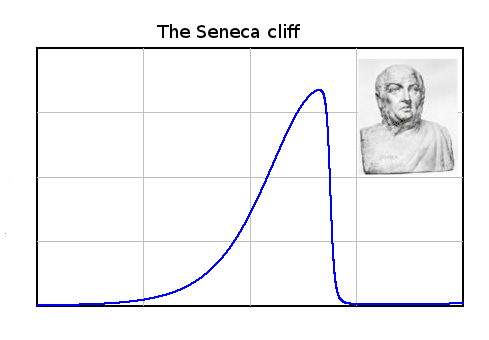 |
| "It would be some consolation for the feebleness of our selves and our works if all things should perish as slowly as they come into being; but as it is, increases are of sluggish growth, but the way to ruin is rapid." Lucius Anneaus Seneca, Letters to Lucilius, n. 91 |
Very often, we fail to understand the delayed effects of our actions. John Sterman reminds us of this point in a talk on global warming quoting Robert Louis Stevenson as saying, "Everybody, sooner or later, sits down to a banquet of consequences." The models shown here tell us that the Seneca cliff is the result of delayed consequences.As always, the future is something that we build with our actions and the models can only tell us what kind of actions will lead us, eventually, to a certain outcome. Used in this way, models can be extremely useful and can even be applied to systems which are much more modest than an entire civilization, for instance to a single company or to our personal relationships with other people. In all cases, the Seneca effect will be the result of trying hard to keep things running as usual. In that way, we may run out faster of the resource that keeps the system running: be it a physical resource or a reserve of goodwill. The way to avoid this outcome may be to let the system run the way it wants, without attempting to force it to go the way we want it to go. In other words we need to take things in life with some stoicism, as Seneca himself would probably have said.Thinking of the worldwide situation and of the problems involved, global warming and resource depletion, what the models tell us is that the Seneca cliff may be the inevitable result of putting too much strain on already badly depleted natural resources. We should try, instead, to develop alternative stocks of resources such as renewable (or nuclear) energy. At the same time, we should avoid to exploit highly polluting and expensive resources such as tar sands, oil shales, deepwater oil, and, in general, applying the "drill, baby, drill" philosophy. All those strategies are recipes for doom. Unfortunately, these are also examples of exactly what we are doing.I don't know what Seneca would say if he could see this planet-wide effort we are making in order to put into practice the idea that he expressed in his letter to his friend, Lucilius. I can only imagine that he would take it with some stoicism. Or, maybe, he would comment with what he said in his "De Providentia" "Let Nature deal with matter, which is her own, as she pleases; let us be cheerful and brave in the face of everything, reflecting that it is nothing of our own that perishes."
15 de agosto de 2011
Um capitalista explica o sarilho em que estamos metidos no que respeita à sustentabilidade e ao aquecimento global, ou, talvez, já agora, a ter de se escolher entre tipos de intervenções malucas, da desejabilidade dos EUA ocuparem, militarmente, Morrocos - acreditem, seria muito mais racional do que terem invadido o Iraque
Sitting in a Panera in Boston’s financial district in early July with Jeremy Grantham, I suddenly found myself considering how I might safeguard my children’s and notional grandchildren’s future by somehow engineering the U.S. annexation of Morocco. Grantham, the founder and chief strategist of the asset-management firm GMO, was reading aloud from a rough draft of his next quarterly letter to investors, in which he ranks some long-term crises of resource limitation along a scale from “merely serious” to “dangerous.”
Energy “will give us serious and sustained problems” over the next 50 years as we make the transition from hydrocarbons — oil, coal, gas — to solar, wind, nuclear and other sources, but we’ll muddle through to a solution to Peak Oil and related challenges. Peak Everything Else will prove more intractable for humanity. Metals, for instance, “are entropy at work . . . from wonderful metal ores to scattered waste,” and scarcity and higher prices “will slowly increase forever,” but if we scrimp and recycle, we can make do for another century before tight constraint kicks in.Agriculture is more worrisome. Local water shortages will cause “persistent irritation” — wars, famines. Of the three essential macro nutrient fertilizers, nitrogen is relatively plentiful and recoverable, but we’re running out of potassium and phosphorus, finite mined resources that are “necessary for all life.” Canada has large reserves of potash (the source of potassium), which is good news for Americans, but 50 to 75 percent of the known reserves of phosphate (the source of phosphorus) are located in Morocco and the western Sahara. Assuming a 2 percent annual increase in phosphorus consumption, Grantham believes the rest of the world’s reserves won’t last more than 50 years, so he expects “gamesmanship” from the phosphate-rich. And he rates soil erosion as the biggest threat of all. The world’s population could reach 10 billion within half a century — perhaps twice as many human beings as the planet’s overtaxed resources can sustainably support, perhaps six times too many.
20 de julho de 2011
Porque razão os movimentos sociais com mais sucesso são extremistas? ou, nesta narrativa existem ensinamentos a retirar para nós outros?
Why do transnational extremist organizations succeed where democratic movements have a harder time taking hold? Maajid Nawaz, a former Islamist extremist, asks for new grassroots stories and global social activism to spread democracy in the face of nationalism and xenophobia. A powerful talk from TEDGlobal 2011.
Interessante, mas, para mim, ainda mais interessante é o que nos pode ensinar sobre o que deveria ser feito nas nossas próprias sociedades onde democracia é, efectivamente, um estado civilizacional, ainda que não tão enraizada, forte, eficaz, como isso - o carácter de um estado civilizacional, a sua resiliência, depende de como responde às grandes crises, e as grandes crises: políticas, económicas, sociais, por vezes transformam-se em crises civilizacionais.
16 de julho de 2011
10 de julho de 2011
Notícias do futuro
Clicar (necessariamente, porque doutro não se percebe a informação) para aceder a uma versão maior.
2 de março de 2011
Charles Koch: sabem quem é? Não?
Pois deveriam sabê-lo!
Second, here’s a joke that’s circulating:A public union employee, a Tea Party activist and Charles Koch are sitting at a table with a plate of a dozen cookies in the middle. Koch takes 11 of the cookies, turns to the Tea Partier and says, “watch out for that union guy he wants a piece of your cookie.”
"- Sent using Google Toolbar"
28 de fevereiro de 2011
Pois...
India’s great moral leader Mohandas Gandhi famously said that there is enough on Earth for everybody’s need, but not enough for everybody’s greed. Today, Gandhi’s insight is being put to the test as never before.The world is hitting global limits in its use of resources. We are feeling the shocks each day in catastrophic floods, droughts, and storms – and in the resulting surge in prices in the marketplace. Our fate now depends on whether we cooperate or fall victim to self-defeating greed.The limits to the global economy are new, resulting from the unprecedented size of the world’s population and the unprecedented spread of economic growth to nearly the entire world. There are now seven billion people on the planet, compared to just three billion a half-century ago. Today, average per capita income is $10,000, with the rich world averaging around $40,000 and the developing world around $4,000. That means that the world economy is now producing around $70 trillion in total annual output, compared to around $10 trillion in 1960 [continuar a ler....]
"- Sent using Google Toolbar"
23 de fevereiro de 2011
Anomalias e notícias do futuro
[....] China's key wheat producing region, lying just south of Beijing, has received just 12 millimeters (1/2 inch) of rain since September, according to the Chinese news service Xinhua. If no rains come during the remainder of February, it could become the worst drought in 200 years. [....] spring in Eastern China has an enhanced probability of being dry, with only a 20% - 25% chance that the region will see above average precipitation, and a 40% - 45% chance of below average precipitation. So the great drought will likely continue, and China's ability to feed itself may be greatly challenged this year.
Impact on global food supplies and food prices
According to the Food and Agriculture Organization of the United Nations (FAO), the drought in north China seems to be putting pressure on wheat prices [....] This has helped push global food prices to their highest levels since the FAO Food Price Index was created in 1990 (Figure 3.) China is the world's largest producer of wheat, and if they are forced to import large amounts of food due to continued drought, it could severely impact world food prices. However, the FAO's regional representative for Asia and the Pacific said in an interview with Reuters last month that the situation is not as severe as in 2008, when global food riots erupted.
The record food global food prices have been partially driven by two other huge weather disasters, the Russian summer heat wave and drought of 2010, and the Australian floods of December - January 2011. Both Russia and Australia are major exporters of grain. [....] The Russian heat wave of 2010 is now estimated by the Centre for Research on the Epidemiology of Disasters to be the deadliest in human history, with 55,736 deaths.[....]
Drought outlook for Northern Hemisphere summer of 2011
The spike in global food prices this winter raises the concern that a severe drought in a major grain producing region in North America, Europe, or Asia this summer could severely impact grain supplies and food prices. Fortunately, with La Niña conditions over the Eastern Pacific weakening, and possibly abating by summer, the chances for such a drought are lower than they would have been if La Niña were to stay strong into the summer.[....]
Commentary
The recent unrest in the Middle East, which has been attributed, in part, to high food prices, gives us a warning of the type of global unrest that might result in future years if the climate continues to warm as expected. A hotter climate means more severe droughts will occur. We can expect an increasing number of unprecedented heat waves and droughts like the 2010 Russian drought in coming decades. This will significantly increase the odds of a world food emergency far worse than the 2007 - 2008 global food crisis. When we also consider the world's expanding population and the possibility that peak oil will make fertilizers and agriculture much more expensive, we have the potential for a perfect storm of events aligning in the near future, with droughts made significantly worse by climate change contributing to events that will cause disruption of the global economy, intense political turmoil, and war. [....]The New York Times' Andy Revkin in his Dot Earth Blog has a more in-depth look at the food and climate change issue that I recommend.
"- Sent using Google Toolbar"
Este blogue é de um meteorologista: - deviam ler a nota na totalidade (e ver as figuras) e acompanhá-lo. Quanto a tempestades perfeitas, e no curto prazo (repito, no curto prazo) só faltaria que, a uma eventual seca em algumas zonas estratégicas do hemisfério Norte se juntassem perturbações significativas na Arábia Saudita.
18 de fevereiro de 2011
Desastres
"... And we need collectively to take steps to realistically address these risks. We need to improve the organizations we create, both public and private, aimed at mitigating large risks. And we need to substantially improve upon the reach and effectiveness of the regulatory systems that govern these activities. But Perrow insists that improving organizations and leadership, and creating better regulations, can only take us so far. So we also need to reduce the scope of damage that will occur when disaster strikes. We need to design our social system for 'soft landings' when disasters occur.
- Sent using Google Toolbar"
Embora, o livro que é recenseado nesta nota tenha como referência os EUA - e o que se diz a esse respeito é muito interessante - o
que se escolheu citar funciona como que um programa de reflexão e de
actuação completo (ao nível de generalidade a que é colocado) para todo o
lado, nestas matérias.
11 de fevereiro de 2011
Explicações
Krugman é um dos economistas que leva a sério as alterações climáticas e as suas consequências. Abaixo três exemplos (devem lê-los na totalidade):
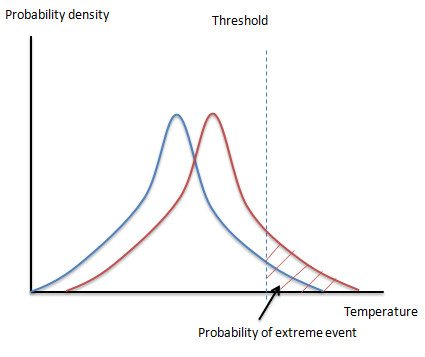
What happens is that the right tail gets fatter: the probability, and hence the frequency, of extreme events goes up.Two immediate implications. First, there will still be cold stretches: global warming shifts the distribution, it doesn’t eliminate the left side of the distribution. So there will still be cold spells; that proves nothing. Second, no individual weather event can properly be said to have been “caused” by global warming. Heat waves happened 30 years ago; there’s no way to prove that any individual heat wave now might not have happened even if we hadn’t emitted all that CO2.But the pattern should have changed: we should be getting lots of record highs, and not as many record lows — which is exactly what we do see. And we should be seeing 100-year heat waves and similar events much more often than history would have suggested likely; again, that’s what we actually do see.
"- Sent using Google Toolbar"
10 de fevereiro de 2011
Sustentabilidade
"Were Chinese oil consumption to reach US per capita levels, its demand would rise ninefold, while Indian consumption would have to go up 23-fold. That would push global oil demand up to 260 million barrels per day, compared with just under 90m barrels a day at present. Clearly, that's not going to happen. But along the way, some combination of much higher prices, a setback to developing nation growth or a switch to alternative fuel sources might be needed; all of which could be very disruptive."
- Sent using Google Toolbar"
8 de fevereiro de 2011
Anomalias
Urp:
The U.N. Food and Agriculture Organization issued an alert Tuesday that a severe drought was threatening the wheat crop in China, the world’s largest wheat producer, and was even resulting in shortages of drinking water for people and livestock. The state-run news media in China warned Monday that the country’s major agricultural regions were facing their worst drought in 60 years and said Tuesday that Shandong Province, a cornerstone of Chinese grain production, was bracing for its worst drought in 200 years unless substantial precipitation came by the end of this month.
[continua com o comentário de Krugman]
"- Sent using Google Toolbar"
2 de fevereiro de 2011
Não que a especulação não possa estar a dar o seu contributo, mas ....
"...the question remains, why did food prices run up this time? Here again, there just doesn’t seem to be much dispute about the major contributing factors, starting with extreme weather. Last month, Scientific American reported, “world food prices hit a record high in December thanks to crop failures from a series of extreme weather events around the world:
FAO attributes the upswing in prices to factors including the crop failures caused by a string of extreme weather events and high crop demands from an ever-increased global population….
Wheat, for example, bludgeoned by Russia’s wildfires, the heat waves in Australia and flooding in Pakistan, saw massive price surges last fall.
- Sent using Google Toolbar"
30 de janeiro de 2011
Causas
"Food prices were driven up by extreme weather and high oil prices
Political unrest has broken out in Tunisia, Yemen, Egypt and other Arab countries. Social media and governmental policies are getting most of the credit for spurring the turmoil, but there’s another factor at play.
Many of the people protesting are also angry about dramatic price hikes for basic foodstuffs, such as rice, cereals, cooking oil and sugar.
This summer’s extreme global weather raised fears of a “Coming Food Crisis,” as CAP’s John D. Podesta and Jake Caldwell warned in Foreign Policy: “Global food security is stretched to the breaking point, and Russia’s fires and Pakistan’s floods are making a bad situation worse.” Earlier this month I discussed how, in fact, “Extreme weather events helped drive food prices to record highs.” Back then, experts were worried about food riots. Now they are happening.
- Sent using Google Toolbar"
Subscrever:
Mensagens (Atom)