Top 5 Fisheries Stories of 2011: It's Not All Bad News | ThinkProgress
27 de dezembro de 2011


26 de dezembro de 2011

Astronomy Picture of Day, 2011 December 26 - Tempestade em Saturno
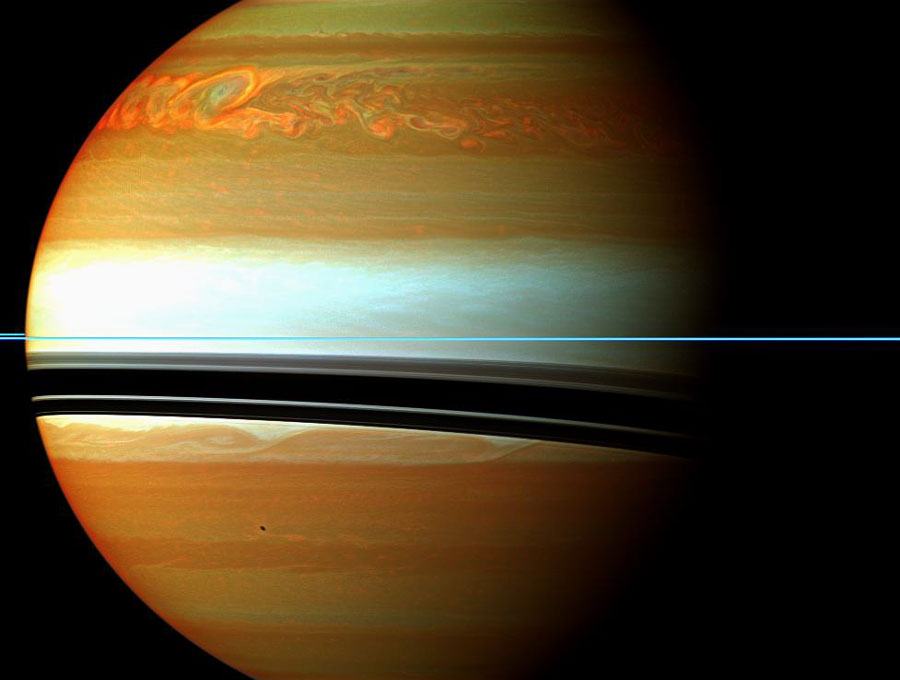 |
| A Raging Storm System on Saturn Image Credit: Cassini Imaging Team, SSI, JPL, ESA, NASA |
Explanation:
It is one of the largest and longest lived storms ever recorded in our Solar System.
First seen late last year, the above cloud formation in the northern hemisphere of Saturn started larger than the Earth and
soon spread completely around the planet.
The storm has been tracked not only
from Earth but from
up close by the robotic
Cassini spacecraft currently orbiting Saturn.
Pictured above in false colored infrared in February, orange colors indicate
clouds deep in the atmosphere, while light colors highlight clouds higher up.
The rings of Saturn are seen nearly edge-on as the thin blue horizontal line.
The warped dark bands are the
shadows of the rings cast onto the cloud tops by the Sun to the upper left.
A source of radio noise from
lightning, the
intense storm may relate to seasonal changes as spring
slowly emerges in the north of Saturn.
23 de dezembro de 2011

Quando em desespero com os políticos, os economistas falam de regras ... à falta de melhor solução ...
Costas Meghir argues that an important element of the Greek malaise is the credibility of Greek politicians and their long history of abusing their power by borrowing vast amounts and spending them to satisfy specific interests and a client-based political system. Their behavior is not a surprise to the student of political economy: politicians, like everyone else, act in their best interest. Constitutions and laws are there to align their interests as far as possible with those of the people they serve. Given the existential crisis of the Greek economy it is now an opportunity to reform the constitution to improve the credibility and incentives of the politicians. Meghir proposes a constitutionally mandated cap on the deficit of 3% and on the debt to gdp ratio of 60%, following a suitable period of adjustment and the necessary restructuring of the debt. He also proposes the abolition of all immunity from prosecution of all government ministers and all members of parliament.
16 de dezembro de 2011


15 de dezembro de 2011
Até aonde se pode ir em termos de dívida externa...

The middle column indicates the room between a country's current debt-to-GDP ratio and the maximum sustainable ratio, according to this analyis. And the right column indicates the maximum yield which, if sustained, will not result in a spiral of collapse (in which rising interest costs make debt less affordable, contributing to rising interest costs). One can quibble with the results; I'm sure there are many people who think markets would abandon America long before its debt-to-GDP ratio topped 200%. But the yield calculations are very interesting.Greece, Portugal, Italy, and Ireland already sport 10-year yields above the make-or-break level. Now, these yields don't bring everything crashing down right away. They have to be sustained, so as to have an impact on actual debt costs as countries are forced to roll over existing debt as it comes due. Spanish yields have been above the critical threshold at times but have since fallen back below it.
13 de dezembro de 2011
Declaração de interesse: nesta matéria eu e a minha mulher situámo-nos no canto inferior esquerdo do gráfico
Comparar o posicionamento de Portugal versus, nomeadamente, a Holanda e a Alemanha.

O ataque à ciência do aquecimento global
Climate scientist Michael Mann from Penn State recently spoke at a TED event, and what he says in this video is nearly the same as in the article I wrote a year ago after hearing Mann speak.
The real shame here is that he needs to keep telling these same stories despite the overwhelming scientific evidence for anthroprogenic climate change.
12 de dezembro de 2011
A guerra de classes e a situação da Eurozona
Excelente explicação por um economista alemão do porquê da criação do euro (não refere, no entanto, todas as razões) e de toda a situação em que a Europa está metida.
11 de dezembro de 2011
Não deveríamos estar todos de acordo com isto? Infelizmente, não estamos - a dúvida está em saber porque assim acontece...
... os grandes problemas na gestão política raramente têm a ver com a escolha entre o bem e o mal. Surgem sobretudo quando se está perante a escolha entre dois males. Quando assim é, são necessárias pelo menos duas cautelas. Primeiro, uma cuidada aferição da malignidade de cada opção, por forma a identificar, com razoável clareza, qual o mal menor e o mal maior.
Segundo, a clarividência necessária para não sucumbir ao fundamentalismo moralista de considerar que mal é mal e, como tal, ambos devem ser recusados, pois a escolha de qualquer deles implicaria sempre a cedência ao mal e, como tal, seria sempre "pecaminosa". Esse fundamentalismo não só é perigoso, do ponto de vista prático - pelas consequências potencialmente desastrosas a que pode conduzir -, como é moralmente errado, porque assenta num vício de raciocínio. O vício desse fundamentalismo consiste em supor que, recusando-se escolher um dos males, se isenta da responsabilidade moral pelas consequências supervenientes. Ora, este é um entendimento profundamente errado do dever moral. Sempre que se está perante uma escolha, está-se perante uma decisão ética (por natureza e definição), não existindo, por isso, nenhum caminho moralmente des-responsabilizante. Mesmo a suposta "não escolha" é sempre uma escolha e influencia o curso dos acontecimentos. Constitui, por isso, responsabilidade moral para quem a pratica.
Mais concretamente e no caso em que se esteja perante dois males, a recusa de escolher activamente o mal menor, implica irrecusavelmente a escolha - "passiva", mas escolha! - do mal maior. A responsabilidade pelo resultado é, pois e sempre, moralmente iniludível, por mais que se pretenda purificar a atitude de recusar escolher. Pense-se no que teria acontecido à Europa e ao Mundo, se as democracias ocidentais tivessem recusado o mal menor - aliança com Estaline - na segunda guerra mundial...
Algumas das leituras sobre a Europa (antes cimeira)
Da mais antiga para a mais recente (antes da cimeira). Aquelas que considero mais interessantes (quaisquer que sejam os motivos) sublinhei-as com o bold.
- Tecnocratas de 5ª linha? E políticos, de que linha?- A Escolha do Editor - Jornal de negócios online
10 de dezembro de 2011
Bem, a verdadeira resposta, se eles andam por aí, passa também, de modo indirecto, por aí ...
 |
| Ver a resposta no canto inferior direito! |
PS (11.12.11): Irra, a epígrafe está escrita de modo confuso, pelo que deverá ler-se do seguinte modo: BEM, A VERDADEIRA RESPOSTA, SE ELES ANDAM POR AÍ, PASSA TAMBÉM, DE MODO INDIRECTO, POR ISTO QUE É SUGERIDO AQUI...
9 de dezembro de 2011
Ter em muita atenção - algumas qualificações, ou mais precisamente, muitas questões, mas explicitá-las daria muito trabalho
Tim Jackson currently serves as the economics commissioner on the UK government's Sustainable Development Commission and is director of RESOLVE -- the Research group on Lifestyles, Values and Environment. After five years as Senior Researcher at the Stockholm Environment Institute, he bcame the Professor of Sustainable Development at University of Surrey, and was the first person to hold that title at a UK university. He founded RESOLVE in May 2006 as an nter-disciplinary collaborationacross four areas -- CES, psychology, sociology and economics -- aiming to develop an understanding of the links between lifestyle, societal values and the environment.
He is also the author of the influential book Propserity Without Growth. He serves as chair to the 'New Energy Solutions' Advisory Board for Danish investment company BankInvest and is associate researcher on a Templeton Foundation project on 'The Pursuit of Happiness.' Tim is also an award-winning playwright, and his environmental drama The Cry of the Bittern won a Public Awareness of Science Drama Award in 1998. His most recent play, Variations, won the 2007 Grand Prix Marulic and is longlisted for the 2008 Sony Drama award.
PS: Acedendo ao You Tube pode-se ver este vídeo legendado em Português
7 de dezembro de 2011
Astronomy Picture of the Day, 2011 December 7 – Kepler 22b: Quase uma Terra para um quase Sol
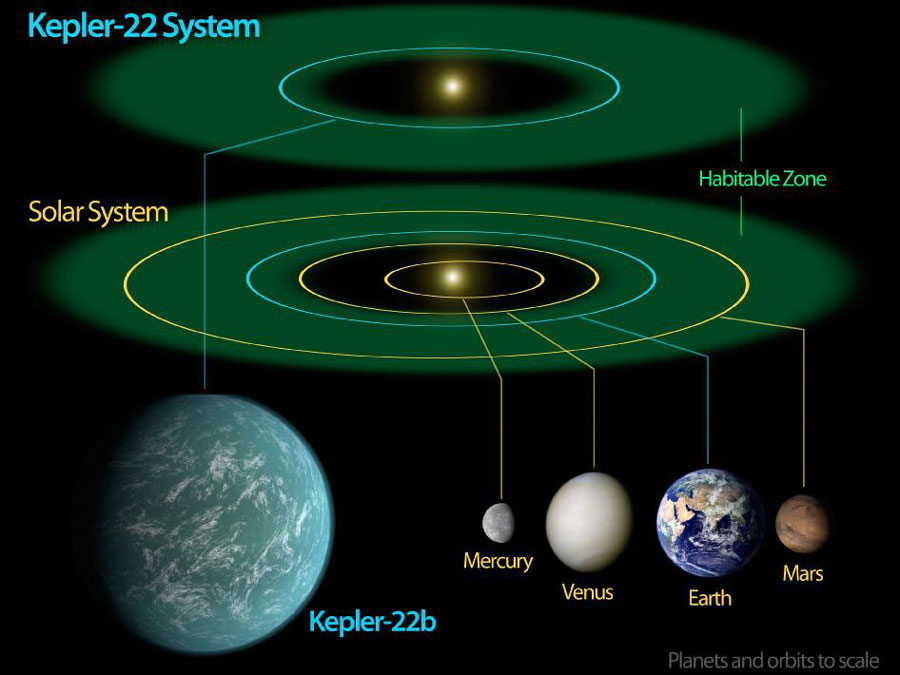 |
| Kepler 22b: An Almost Earth Orbiting an Almost Sun Illustration Credit: NASA / Ames / JPL-Caltech |
Explanation:
It’s the closest match to Earth that has yet been found.
Recently discovered planet Kepler 22b has therefore instantly become the
best place to find life outside our Solar System.
The planet's host star,
Kepler 22, is actually slightly smaller and cooler than the
Sun, and lies 600
light-years from Earth toward the constellation of the Swan
(Cygnus).
The planet,
Kepler 22b, is over twice the radius of the Earth and orbits slightly closer in, but lies in the
habitable zone where liquid water could exist on the surface.
Pictured above is an artist’s depiction of how
Kepler 22b
might appear to an
approaching spaceship,
in comparison to the inner planets of our Solar System.
Whether Kepler 22b actually contains water or life is currently unknown.
A SETI project, however, will
begin monitoring Kepler 22b for signs of intelligence.
5 de dezembro de 2011
Primeiro planeta extra-solar confirmado na zona de habitabilidade de uma estrela tipo Sol
 |
| Artist's conception of Kepler-22b. Credit: NASA/Ames/JPL-Caltech |
Scientists from the Kepler mission announced this morning the first confirmed exoplanet orbiting in the habitable zone of a Sun-like star, the region where liquid water could exist on the surface of a rocky planet like Earth. Evidence for others has already been found by Kepler, but this is the first confirmation. The planet, Kepler-22b, is also only about 2.4 times the radius of Earth, the smallest planet found in a habitable zone so far, and orbits its star, Kepler-22, in 290 days. It is about 600 light-years away from Earth, and Kepler-22 is only slightly smaller and cooler than our own Sun. Since its mass is not yet known, it is not known yet if it is a rocky or gaseous planet, but its discovery is a major step toward finding Earth-like worlds around other stars. A very exciting discovery, but there’s more…
It was also announced that Kepler has found 1,094 more planetary candidates, increasing the number now to 2,326! That’s an increase of 89% since the last update this past February. Of these, 207 are near Earth size, 680 are super-Earth size, 1,181 are Neptune size, 203 are Jupiter size and 55 are larger than Jupiter. These findings continue the observational trend seen before, where smaller planets are apparently more numerous than larger gas giant planets. The number of Earth size candidates has increased by more than 200 percent and the number of super-Earth size candidates has increased by 140 percent.

Subscrever:
Mensagens (Atom)